

I get asked this question a lot. Both in DMs and at the shop. Someone comes in, eyes wide, holding two different boxes. In one hand, a Pop Mart MOLLY blind box, featuring the whimsical art of Kenny Wong. In the other, one of those MGA Miniverse "Make It Mini" capsules.
"What's... The difference?" they ask. "They're both just `mini collectible` toys, right?"
Wrong. So, so wrong.
And that's the conversation I want to have today. Because on the surface, they look similar. Small box, element of surprise, the dopamine hit of opening something new. But underneath that shiny foil wrapper are two completely different philosophies, two different communities, and two wildly different collecting experiences. As someone who lives and breathes this stuff, I feel like I need to set the record straight.
This isn't just about `small figurines collectables`. It's about what kind of joy you're chasing.
The Two Worlds of Mini: The Artist vs. The Object
Let's break it down. Pretty much every `mini collectible` falls into one of two camps.
Camp A: The Designer Art Toy
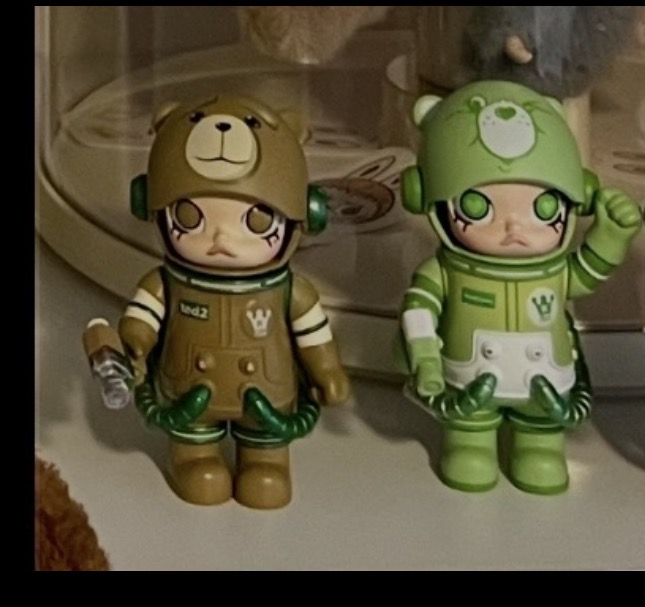
This is our home turf at PopNya. This is your MOLLY, your Skullpanda, your Dimoo, your Labubu. These aren't just `mini figures toys`; they are miniature sculptures.
The key thing to understand here is the artist. Someone, a real person like Kenny Wong (for MOLLY) or Kasing Lung (for Labubu), designed this character. They have a story, a personality, a distinct aesthetic. You're not just collecting a toy; you're collecting a piece of that artist's vision, shrunk down to fit on your desk.
These are often sold as `mystery figures` in blind boxes. You buy a box from a series, but you don't know which of the 12 (or so) designs you're going to get. It's a gamble. And that's part of the appeal. You're hunting for your favorite design, or maybe, just maybe, you'll pull the "secret" or "chase" figure, a super rare design that can be worth a small fortune on the secondary market.
You might collect every figure in the MOLLY MEGA Space series because you love the character of MOLLY and how she's reinterpreted in this futuristic theme. Or you might just collect all the cat-themed figures from different artists. The collection tells a story about your taste in art. If this sounds like your vibe, you can `browse MOLLY figures` in our shop to see what I mean.
Camp B: The Miniature Replica
This is the other side of the coin. Think Zuru Mini Brands, MGA's Miniverse, or even those tiny, perfect Japanese Re-Ment sets.
The goal here isn't character, it's realism. The thrill comes from the shocking accuracy of a tiny, perfect bottle of Heinz Ketchup or a miniature Breyers ice cream tub.It's a craft project and a collectible in one.
These are often sold in `mini box toys` or capsules, but the "chase" is different. It's less about finding a single, artist-signed golden ticket and more about completing a set. "I just need the tiny jar of pickles to finish my miniature pantry!" It taps into that same part of the brain that loves dollhouses, model trains, and perfectly organized spaces.
The collecting journey is about recreating the world in miniature. It's about the ASMR-like satisfaction of the "make," the nostalgia of seeing your favorite brands as `little collectible toys`, and the sheer, almost comical, delight of the tiny scale.
The Real-World Difference: A Head-to-Head Breakdown
So, how do these two worlds actually stack up when you're the one spending the money? I handle these things every day, so let's get into the nitty-gritty.
The "Gacha" Game & The Weight Trick Myth
Everyone wants an edge in the blind box game. The oldest trick in the book is trying to weigh the boxes to guess what's inside.
Real Talk: For modern designer art toys from a major brand like Pop Mart, the box weight trick is dead. I can say this with 100% certainty because I've seen the pallets. Back in the day, maybe 5-6 years ago, you could sometimes feel a difference. A figure with a big hat or a heavy accessory would be noticeably heavier.
Not anymore. The manufacturers got wise. Now, inside each box, they include little custom-cut cardboard inserts. Their sole purpose is to normalize the weight and size across the entire series. The box with the tiny, simple figure has a big piece of cardboard. The box with the huge, complex figure has a tiny piece. They all feel almost identical. I've seen people bring tiny digital scales into stores, and honestly, it's just a waste of time. You look silly, and it doesn't work.
Miniature replicas are a bit different. With something like a Miniverse ball, the contents (bottles of resin, different plastic pieces) can have more variation in weight and sound. You can sometimes get a clue by shaking it, but it's still a long shot.
The true gamble remains with the `mystery figures` from the art toy world. The odds are printed on the box (e.g., 1/144 for a secret), and that's the only truth you can rely on.
Value, Hype, and The Aftermarket Nightmare
This is where things get really interesting, and potentially dangerous for your wallet.
An art toy `mini figures collectibles` series has a crazy value curve. Let's take a standard MOLLY figure. It retails for about $15-$17. Most of the 12 regular figures in the set will hover around that price on the secondary market, maybe dipping to $10 or rising to $25 for a popular design.
But the secret figure? That's a different beast. On release day, a hot secret can easily fetch $150. I've seen some go for over $300 in the first 48 hours. For example, the secret "Inc" from the MOLLY x Warner Bros. 100th Anniversary series was trading for insane amounts right after release because it was so unique. It's a stock market, and the volatility is wild.
Honest Warning: This is also a trap. I've seen collectors, especially new ones, get caught up in FOMO (Fear Of Missing Out) and drop $200 on a secret, only to see the price crash to $90 a month later as more get unboxed and supply increases. My advice: Never buy a secret on release week unless you have money to burn. Wait for the hype to die down. Collect what you genuinely love, not what you think is a good investment. Most of the time, it isn't.
Miniature replicas have a much flatter, more stable aftermarket. A rare Mini Brand might go from its $7 retail price to maybe $20 or $30. There are exceptions, like the "frozen moment" or gold rush items, but you rarely see the 10x or 20x price jumps common in the art toy scene. It's a less lucrative, but also much safer, secondary market.
Quality, Feel, and That "In-Hand" Experience
You can't get this from an unboxing video. You have to feel it.
A good designer art toy, like one from our `MOLLY collection`, has a satisfying heft. It's typically made from high-quality PVC. The paint is crisp. The seams are minimal. When you hold the MOLLY "Disguise" figure, you can feel the subtle texture on her little animal costume." A detail I noticed recently: the latest batches of the MEGA Space MOLLY series have a slightly more matte finish on the suit compared to the first run, which I think looks better and shows fewer fingerprints. That's a tiny detail you only notice when you've handled hundreds of them.
Miniature replicas are all about a different kind of quality: the magic of the materials. The "resin" in a Miniverse kit has a specific viscosity to mimic real food. The tiny paper labels are printed with incredible precision. The joy is in the assembly and the final illusion. The downside? Sometimes the illusion fails. I've had plenty of customers (and I've experienced this myself) complain about Miniverse resin that won't cure properly under the UV light, or a tiny label that was printed off-center. The quality control is more about the idea than the physical object you hold at the start.
Our Take: The Real Talk on Which to Collect
Look, I'm biased. I run PopNya. My shelves are lined with `mini figures collectibles`, not tiny Tide bottles.
For me, it's not even a contest. The designer art toy is a richer, more engaging hobby.
Why? Because of the connection.
When I get a new MOLLY, I'm not just getting a piece of plastic. I'm getting a new chapter in a story I've been following for years. I'm seeing how Kenny Wong's art has evolved. I'm connecting with a character that has a defined personality. These `small figurines collectables` have a soul. They look back at you. A tiny box of fake Nerds candy doesn't.
The thrill of hunting a secret is also a different kind of thrill. It's not about completing a checklist; it's about finding a rare piece of art. It's like finding a signed print in a stack of posters. The community reflects this. Trading a duplicate art toy is a conversation about artists and aesthetics. Trading a duplicate Mini Brand is a transaction.
That said, I'm not a hater. I get the appeal of the mini replicas. If you're someone who loves crafting, ASMR, and the quiet satisfaction of a project well done, Miniverse is probably your jam. If you have deep nostalgia for the grocery store aisles of your childhood, Zuru Mini Brands will hit you right in the feels. They are an exercise in technical marvel and nostalgic comfort.
But if you're looking for something with a story... Something with a point of view... Something that feels less like a product and more like a personality? You belong in the world of designer art toys.
It's a more volatile, sometimes more frustrating world. You'll get duplicates. You'll miss out on drops. You'll see a secret you desperately want sell for the price of a car payment. But the highs are so much higher. Unboxing that one figure you've been searching for, the one that completes your display, the one that just speaks to you... There's no other feeling like it. It's the difference between collecting products and curating art.
So next time you're standing there with two different `mini box toys` in your hands, ask yourself what you're really looking for. A tiny, perfect copy of the world? Or a tiny, perfect world all its own?
--- Disclosure: PopNya may earn a commission if you purchase through links on this page.


