

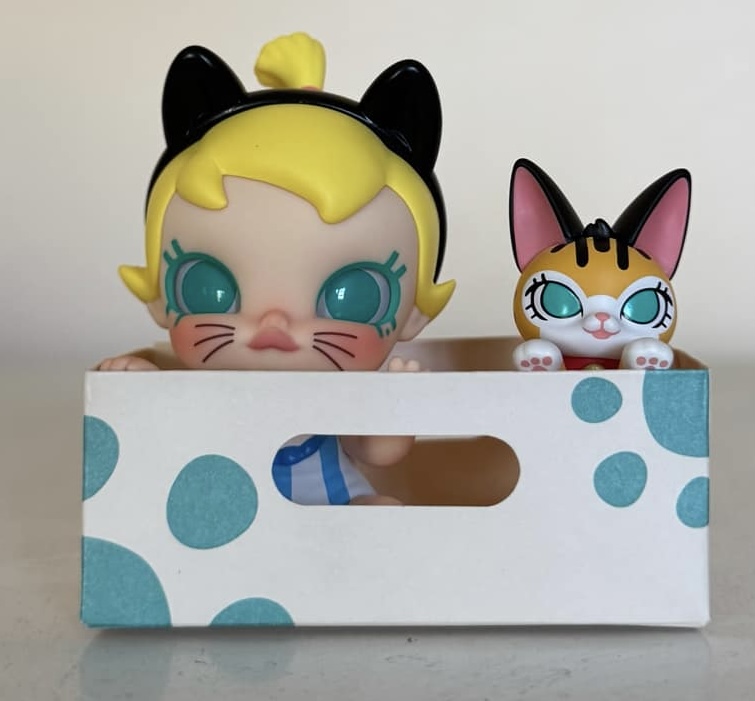
I still remember the one that started it all for me. It wasn't even in a blind box. It was a MOLLY figure, the Ocean series version, sitting by herself on a shelf in a small shop in Hong Kong. The little pout, the oversized helmet, the sheer confidence in her stance. It was more than just "cute." It had personality. I bought her, brought her home, and a corner of my desk has been occupied by designer toys ever since.
That feeling is what I chase. But after years of collecting and running PopNya, I've seen how the explosion of cute collectibles can be a minefield. It's easy to get swept up in the hype, spend a ton of money, and end up with a shelf of things that don't spark that same joy.
So, this isn't going to be a list of "top 10 cute toys." This is my personal rulebook. The stuff I wish someone had told me when I started.
Rule #1: Look for the Artist, Not Just the Aesthetic
This is the biggest one. So many things are labeled "cute" now.The difference is the artist.
When you buy a MOLLY, you're not just buying a vinyl figure of a girl with a pouting lip. You're buying a piece of Kenny Wong's universe. You're collecting a character with a history, an evolution. You can see his style change and grow from the very first series to the latest collaborations. The same goes for Kasing Lung's Labubu or Ayan Deng's Dimoo. These are characters born from an artist's vision.
A lot of the newer, factory-born characters lack this soul. They're designed by committee to hit every "kawaii" checkbox: big eyes, pastel colors, maybe an animal costume. They're fine. But they often lack a point of view. They feel hollow.
Before you buy, ask yourself: Who made this? Is there a story behind it? Can I see a consistent artistic voice across the series? If the answer is no, you might just be buying a well-marketed piece of plastic. It's a key point in the whole art toys vs. Mini replicas debate; one has a soul, the other is just a small copy of something. Collecting an artist's work feels like you're on a journey with them. Collecting a corporate mascot feels... Well, like you're just consuming a product.
Rule #2: The Blind Box "Tricks" Are Mostly a Lie
Let's talk about blind boxes. The thrill, the gamble, the dopamine hit. I get it. But I also see so much bad advice online.
The most common one? The box weight trick.
The theory is that you can use a sensitive scale to weigh sealed blind boxes and figure out which character is inside. The heavier box must be the one with the big accessory, right? The lighter one is the simple design.
Real Talk from a Seller: This doesn't work anymore. Maybe, maybe ten years ago on a specific first-run series, you could get away with it. But manufacturers like POP MART are way ahead of you. I've personally handled cases from the last two years, and the consistency is incredible. Newer series often have standardized plastic inserts. Some even have little cardboard counterweights tucked into the packaging for the "lighter" figures to make them all feel identical. I've seen it myself when breaking down boxes for recycling. It's a tiny, folded piece of cardboard you'd never notice unless you were looking for it.
So please, don't be that person in the store with a pocket scale. It doesn't work, and you look silly.
The only "trick" that has any merit is buying a sealed case. A factory-sealed case (usually of 12 boxes) guarantees you'll get a full set of the regular figures without duplicates, and it gives you the best statistical chance of pulling a secret or "chase" figure. If you're serious about a series, splitting a case with a friend is the most economically sound way to do it.
Rule #3: Understand the Hype Cycle (and Learn to Ignore It)
The market for cute collectible toys is driven by hype. FOMO, Fear Of Missing Out, is a powerful marketing tool. A new series drops, Instagram goes crazy, and suddenly a figure that costs $15 is being flipped for $100.
My advice? Breathe.
I saw this happen with the MOLLY x Warner Bros. 100th Anniversary series. The Bugs Bunny MOLLY was an instant hit. Retail was about $17. Within a week, I saw listings on secondary market sites for $60, $70, $80. People were panicking, thinking they'd missed their chance.
And then... POP MART restocked. The prices crashed back to earth. A month later, you could get one for $25-$30. The people who waited saved a lot of money.
Here's my playbook for navigating hype: 1. The 30-Day Rule: Unless it's a super limited, numbered, event-exclusive release, wait 30 days. See where the market settles. Hype is a fire that burns hot and fast. It rarely lasts. 2. Identify the "Grail": In every series, there's usually one or two figures that become the fan favorites. Learn to spot them. It's often the one with the most intricate design, the pop culture reference, or the best accessory. That's the one whose price might actually hold or increase. The rest will likely drop. 3. Know the Difference Between "Rare" and "Hyped": A secret/chase figure with a 1/144 ratio is genuinely rare. A regular figure that everyone on TikTok is suddenly obsessed with is just hyped. The price of the hyped figure will fall. The price of the rare one might not. Understanding this is key, especially when you start looking at true grail-level pieces like The Royal MOLLY, where rarity and artistry create lasting value.
Don't let FOMO dictate your collection. A collection built on panic-buying is a collection you'll eventually resent.
Rule #4: Quality Is in the Details You Can't See Online
Pictures lie. Or rather, they don't tell the whole story. Some of the most disappointing figures I've ever bought looked amazing in the promo shots. When they arrived? Cheap, hollow-feeling plastic. Messy paint lines. Seams that didn't quite line up.
Here are the things I look for when I have a figure in my hand. These are the markers of quality that separate the good stuff from the junk.
* The Weight: A quality vinyl figure has a certain heft. It feels solid, not like a cheap gachapon toy. It shouldn't feel hollow or brittle. * The Seams: Look at where the different parts of the mold come together. On a high-quality figure, the seams are clean, minimal, and well-hidden. On cheap figures, you'll see ugly, raised lines, especially around the head or limbs. * The Paint: Look closely. Are the lines crisp? Is the color even? Is there overspray? One of my pet peeves is seeing a speck of black paint on a figure's white face. A good manufacturer has high quality control to prevent this. Also, feel the finish. Is it a smooth matte? A glossy coat? Does it feel tacky? (A tacky or sticky finish can be a sign of poor quality vinyl or paint that hasn't cured properly, a problem I've noticed on some knock-offs). * The Feet: This is a pro tip. Turn the figure over. Look at the feet. This is where the copyright information is. On a legit figure from a major brand like POP MART, you'll see crisp, clear text: the artist's name, the company, the year. On fakes, this text is often blurry, misspelled, or missing entirely. It's the first thing I check.
If you're just starting to look for cute figures to collect, it can be hard to know what "good" feels like. My advice is to go to a physical store if you can. Pick up a MOLLY. Pick up a Dimoo. Feel the quality. Then, when you're shopping online, you'll have a baseline for what to expect. It's why I'm so picky about the brands we carry at PopNya; I need to feel that quality myself before I'll ever sell it to you.
**Our Take: The Real Secret to Collecting
Okay, here's my honest-to-god opinion as someone who lives and breathes this stuff. The "cuteness" is the hook, not the substance. It's what gets you in the door. But it's not what makes a collection meaningful. I have boxes of figures I bought because they were "cute" that are now just gathering dust. They were impulse buys, a quick sugar rush of consumerism.
The figures that stay on my desk, the ones I truly love, are the ones with a story. The MOLLY that reminds me of that trip to Hong Kong. The Skullpanda that perfectly captures a mood I was feeling. The Dimoo that my friend got me for my birthday.
A great collection isn't just a display of expensive or rare items. It's a physical manifestation of your own taste, your memories, and your journey. It tells a story about you. So don't just ask "is this cute?" Ask "does this speak to me?"
If you're looking for figures that do more than just look cute, that have that depth and artistic story behind them, the classic MOLLY collection is honestly the perfect place to start. You can see the evolution of an artist and a character over more than a decade. Each series tells a different story, but the core personality always shines through.
Ultimately, the goal isn't to own every cute thing. The goal is to curate a small world of characters that make you happy, that inspire you, and that feel like an extension of your own personality. That's a collection that's truly priceless.
* Disclosure: PopNya may earn a commission if you purchase through links on this page.


