

I get this question a lot. In DMs, at toy meetups, from people new to the hobby. They'll pick up a Skullpanda box, feel the weight, and ask, "Is Pop Mart Chinese?"
The simple answer is yes. Absolutely. Pop Mart is a Chinese company through and through. It was founded in Beijing in 2010 by a guy named Wang Ning. If you want the full corporate backstory, you can read up on who owns Pop Mart and the founder's journey, but the short version is they started as a lifestyle retail shop and then exploded when they pivoted to designer toy blind boxes. So, where is Pop Mart based? Beijing. That's the home base.
But honestly, that's the least interesting part of the story.
The question people are really asking is more complex. They're asking about quality. They're asking about culture. They're asking if this is just another "Made in China" product or something different.
And it is something very, very different.
Beyond the "Made in China" Sticker
Look, almost every designer toy you own is physically made in China. Your Kidrobot Dunnys, your Superplastic figures, even many Japanese Medicom Toy releases. The country has the manufacturing infrastructure. It's just a fact of the global supply chain. For years, being a Pop Mart manufacturer meant using this infrastructure.
But Pop Mart isn't just manufactured in China. Its entire identity, its business model, and its meteoric rise are deeply, fundamentally rooted in modern Chinese youth culture. This isn't an American or Japanese company outsourcing production. This is a Chinese brand that mastered its home turf and is now exporting that specific cultural formula to the rest of the world.
That's the part that most articles miss. They give you the Wikipedia facts. They don't tell you why it feels the way it does when you walk into one of their stores or what's driving the whole phenomenon.
So, why is Pop Mart so popular? It's not just because the toys are cute. They cracked a code.
In mainland China, young adults face immense pressure. The "996" work culture (9 am to 9 pm, 6 days a week) is real. Academic and career competition is off the charts. Pop Mart offered a hit of dopamine, an affordable luxury, a "small joy" that was accessible. For the price of a few fancy coffees, you could get the thrill of the chase, the surprise of the unboxing, and a beautiful little object for your desk.
They built an entire ecosystem around this. They integrated with WeChat for social sharing. They created a robust online community. They turned the act of collecting into a social game. The blind box wasn't just a product; it was an event. This is the engine behind the brand. It's a machine built by and for the specific anxieties and desires of a generation of Chinese consumers. And now, that machine is going global.
Real Talk: The Collector's Verdict on "Chinese-ness"
Okay, so as a seller and a collector, what does this all mean for the actual toys in our hands? Let's be real.
On Quality: The quality conversation is nuanced. Because Pop Mart is a Chinese company with direct control over its production lines, they have an insane ability to scale. But this scale can be a double-edged sword.
I've seen it firsthand. The early MOLLY series, while charming, can feel a bit lighter, the paint a little less crisp than the newer stuff. The recent Skullpanda "Image of Reality" series or the MOLLY "A Boring Day" series have a heft and a matte finish that feels incredibly premium. The improvement is undeniable. They are reinvesting their massive profits back into production quality.
However, I've also seen dips. Around 2021, when they were expanding at a breakneck pace, I got a few cases of a certain series (I won't name names, but it involved cute animals) where the QC was just... Off. A smudge of paint here, a loose joint there. It felt rushed. Because they operate at such a massive volume for the Pop Mart in China domestic market, sometimes the international batches can reflect those production crunches. It's gotten much better recently, but it's something I always watch for when a new series drops.
Insider Detail: One thing I've noticed is that the packaging for the mainland China market can sometimes have different promotional stickers or inserts compared to the international releases. It's a small thing, but it's a reminder of where the brand's focus primarily lies. The global market is a huge and growing priority, but the Chinese domestic market is the mothership.
On Hype and Availability: This is where their origin really impacts us as collectors. Pop Mart can create a frenzy like no other brand. They can seed a new release with thousands of influencers on Weibo and Douyin (the Chinese TikTok), creating a tidal wave of hype that spills over into the global market before the figures even land in US stores.
The Labubu Macaron series is a perfect example. It exploded in Asia first. By the time it got an official US release, the secondary market was already going wild based on the demand from China. I saw the "Soymilk" variant, a regular figure, selling for $50+ before most of us could even buy a box at retail. The secret "Toasted" was hitting $300+. That's the power of their home market.
This can be frustrating. It can feel like we're always playing catch-up. But it also means the brand has the capital to open stunning physical stores, like the ones I've visited and written about. Seeing the Pop Mart store in NYC or the massive presence in other cities is a direct result of their success in China. They have the money to build brand embassies, not just retail shops.
The Artists: A Global Roster on a Chinese Platform
Here's another layer of complexity. Pop Mart itself is a platform, not a single artist. They collaborate with creators from all over the world.
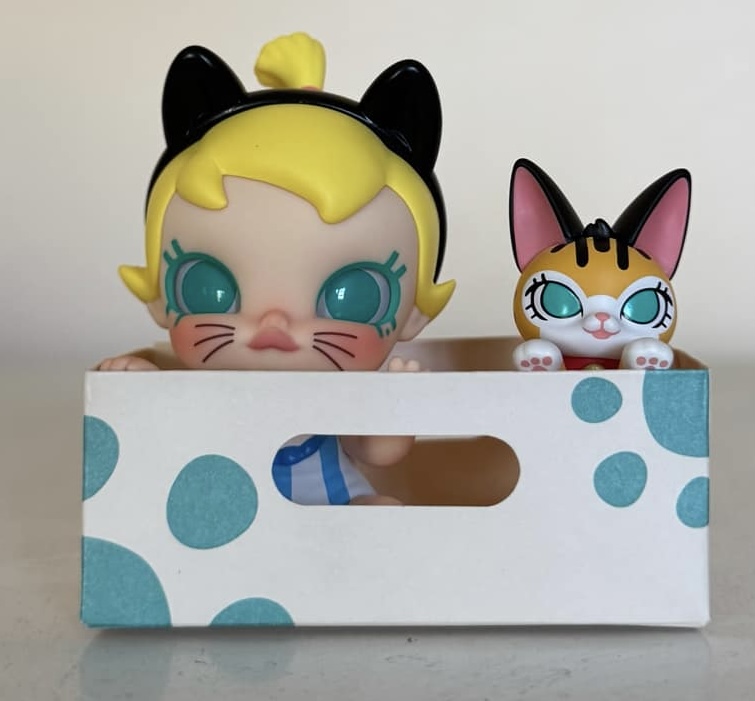
- Kenny Wong (MOLLY): He's from Hong Kong. MOLLY existed before Pop Mart, but they took her to the stratosphere. His art is the foundation of my own collection, and browsing the full MOLLY collection shows the incredible evolution of his work on their platform.
- Kasing Lung (Labubu): Also from Hong Kong, but based in Europe. His whimsical, slightly monstrous creations have a distinctly European storybook feel.
- Skullpanda: A mainland Chinese artist whose edgy, futuristic, and fashion-forward designs represent a completely different aesthetic. Her success is a testament to the creative talent coming from within China itself.
- Dimoo World: The artist, Ayan Deng, is also from mainland China.
So while the platform is Chinese, the art is global. This is a smart strategy. It allows them to appeal to different tastes and gives the brand a more international feel, even though the business engine is 100% Chinese. They provide the manufacturing, marketing muscle, and retail footprint that these independent artists could never achieve on their own.
It's a powerful symbiosis. The artists get massive exposure and financial security. Pop Mart gets a continuous stream of fresh, exciting IP to feed into its blind box machine. It's a model that has completely reshaped the designer toy landscape, moving the center of gravity from Japan and the US firmly toward Beijing.
So, Does It Matter That Pop Mart is Chinese?
Yes. It matters immensely.
It matters because their understanding of hype cycles, social commerce, and the "collecting as a lifestyle" phenomenon is second to none. It's why they can make a character like Labubu a global sensation in a matter of months.
It matters because their financial and manufacturing power allows them to dominate the market. They can out-produce, out-market, and out-sell almost any other designer toy company on the planet right now. This is why you're seeing them in shopping malls and not just in niche collector shops. This is why a deep dive into what a Pop Mart is reveals a retail juggernaut, not just a toy company.
And it matters because it is a major shift in cultural exports. For decades, it was American and Japanese IP that dominated the globe. Pop Mart is one of the first truly global brands of the new millennium to export a uniquely Chinese consumer culture along with its products.
For us collectors, it's a mixed bag. We get more toys, more variety, and more beautiful stores. We also get more hype, more competition for rare pieces, and the feeling of being a small part of a colossal global machine. The days of designer toys being a small, underground hobby are over, and Pop Mart is the main reason why. They put these little vinyl figures on the real 'toys top toys' list, whether the mainstream industry knew it or not.
So the next time someone asks you if Pop Mart is Chinese, you can say, "Yes. And that's the whole story." It's the key to understanding everything from the price of that secret you're chasing to the reason you can now buy a MOLLY figure at your local mall. It's not just a country of origin. It's the brand's entire DNA.
Disclosure: PopNya may earn a commission if you purchase through links on this page.


