

*
Okay, let's just get it out there. The first time most people see a LABUBU, especially if they're not already deep in the designer toy world, a little lightbulb goes off. It's a dim, nostalgic, 1960s-children's-book kind of lightbulb.
"Hey," they say, pointing at a shelf in my store or a picture on their phone. "That looks like one of the Wild Things."
And I get it. I really do. I nod. I smile. Because on the surface, they're not wrong. You see a mischievous little monster with pointy ears (sometimes), a wide mouth, and a generally chaotic vibe, and your brain immediately rummages through its files for a match. For millions of us, that file is labeled "Maurice Sendak."
This whole where the wild things are vs labubu debate is probably the most common entry point for people discovering Kasing Lung's universe. It's a constant topic on Reddit, a flurry of comments on TikTok, and a question I get in my DMs at PopNya at least once a week. But as a collector and seller who handles these figures every single day, I can tell you the comparison, while understandable, barely scratches the surface.
And honestly? It kind of misses the point of both.
The Case for the Comparison: Why Your Brain Goes There
Let's be fair. The initial visual connection is undeniable. If you put a picture of Moishe or Bernard from Sendak's book next to a classic LABUBU, you can draw some lines.
The "Monster" Vibe: Both are fundamentally "monsters" that aren't truly scary. They have a wild, untamed energy but are ultimately endearing. They're creatures you'd want to join for a "wild rumpus," not run away from screaming. This shared archetype is powerful.
The Toothy Grin: LABUBU's signature look is that wide, slightly mischievous grin, usually showing off two prominent bottom teeth. Some of the Wild Things rock a similar dental situation, with mouths full of big, blocky teeth that are more expressive than menacing.
The Horns/Ears: This is a big one. The classic LABUBU silhouette is defined by those long, rabbit-like ears. Many of the Wild Things have horns. In a quick glance, the pointy things on the head register as "monster-like," and the brain connects the dots. It's a simple, effective visual shorthand that both artists use, albeit for different characters. The whole labubu looks like where the wild things are idea often starts and ends right here.
So yes, if you're just looking at a single image, especially a where the wild things are book labubu side-by-side, the comparison feels solid. It's a monster. It has pointy bits. It looks like it might cause some trouble. Case closed?
Not even close.
A Deeper Look: Where the Comparison Falls Apart
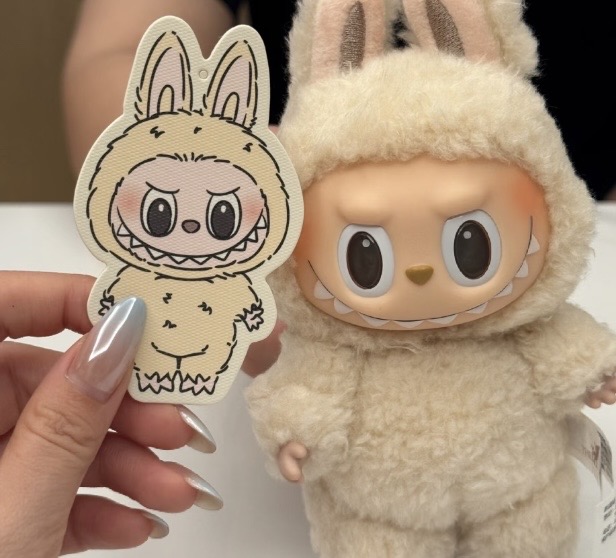
This is where my experience as a collector kicks in. When you've unboxed hundreds of these, felt the different materials, seen the evolution of the character, and spent time with Kasing Lung's wider body of work, the differences aren't just details, they're the whole story.
Kasing Lung's Actual Inspiration
Here's the single biggest piece of information that gets lost in the social media chatter. Kasing Lung, the creator of LABUBU, is a Hong Kong-born artist who grew up in the Netherlands. His primary inspirations aren't American children's books. He has consistently cited old European and Nordic folklore, the world of fairies, elves, and forest spirits, as the foundation for "The Monsters" universe.
Think about that for a second. His inspiration comes from the same ancient, primal soup of stories that gave us gnomes, trolls, and goblins. These are creatures of the woods, mischievous and mysterious. LABUBU isn't a "Wild Thing" from a boy's imagination; he's a fairy, an elf, a little monster spirit. His name itself, "LABUBU," doesn't have a specific meaning; it's meant to sound like a magical word, a name from a forgotten fairy language.
This context changes everything. It reframes LABUBU from being a reaction to Sendak's work to being a parallel creation drawing from a completely different, much older well of inspiration.
LABUBU vs. A "Wild Thing"
Let's put them head-to-head.
A "Wild Thing" is a psychological manifestation. They are the embodiment of Max's anger and frustration. They are big, emotional, and ultimately exist to be conquered and ruled by their king. They are characters in service of a narrative about mastering one's own emotions. Their designs are brilliant, but they are static characters within a single, perfect story.
LABUBU is a character, not a concept. He has a personality. He's curious, naughty, and a little bit naive. He's not a stand-in for an emotion; he's a little guy going on adventures. He's part of a whole family of characters, the stoic Zimomo, the shy Tycoco, the ghostly Spooky. This isn't just one monster; it's a whole society.
The biggest difference is LABUBU's role as a canvas. Think about the blind box series. We have LABUBU as food in the Exciting Macaron Labubu series. We have him as a pirate in the One Piece crossover. We have him cosplaying as other monsters. The Wild Things could never do this. Their identity is locked into their story. LABUBU's identity is his adaptability. He is a character actor, and that's a fundamental difference in design philosophy.
Real Talk: My Honest Verdict as a Seller
Okay, let me just say it. The labubu wild things comparison is lazy.
It's a fine first impression, but holding onto it is like saying all rock music sounds like The Beatles. It ignores decades of evolution, nuance, and artistry.
From my side of the counter, the comparison is a tell. I can almost always guess how new someone is to the designer toy scene based on how heavily they lean on the "Wild Things" angle. Seasoned collectors don't make the comparison. Not because they're snobs, but because they've moved past the surface-level visuals and are deep into the lore, the artist's intent, and the physical object itself.
And that's another thing, the object. A book illustration is a 2D experience. A LABUBU figure is a 3D object. I've held thousands of them. I know the specific matte finish on the Fall in Wild series. I know the satisfying heft of the "Big" Into Energy figures. I know the subtle texture differences between a Pop Mart release and an older How2Work piece. The joy of LABUBU is tactile. It's the weight in your hand, the smooth vinyl, the precise paint application.
You can't get that from a book.
The comparison does a disservice to both artists. It flattens Maurice Sendak's groundbreaking psychological storytelling into "a book with some cool monsters." And it reduces Kasing Lung's entire universe, built over more than a decade, to "a toy that kinda looks like those monsters."
What This Means for You, the Collector
So, where does this leave us? If you're new to the scene and this comparison was your entry point, welcome! There's no shame in it. But I encourage you to go deeper.
Don't just stop at "it looks like a Wild Thing." Ask why. Discover Kasing Lung's European folklore influences. Explore the other characters in The Monsters family. Dive into the back catalog of releases. You'll find a world that's so much richer and more rewarding. If you want a primer, our Ultimate Guide to LABUBU Dolls is a great place to start your journey beyond the initial comparison.
Does the similarity affect the value or collectibility? Absolutely not. The LABUBU market is white-hot on its own terms. People aren't paying hundreds of dollars for a chase figure because it reminds them of a book they read as a kid. They're paying for the artistry of Kasing Lung, the scarcity, and the thrill of the hunt within the LABUBU ecosystem.
In the end, the where the wild things are labubu connection is a fun, but fleeting, observation. It's the first step on a path, not the destination. The real magic happens when you leave that comparison behind and let the wild rumpus of LABUBU's own world begin.
Com/collections/labubu). You won't find any of Sendak's creations there, but you will find a whole universe of mischievous, adventurous, and utterly original monsters waiting for you.
* Disclosure: PopNya may earn a commission if you purchase through links on this page.


