

The question lands in my DMs at least three times a week. "Hey, is this a Lafufu?" followed by a blurry photo of a monster toy that looks… off.
So, let's just get it out of the way. What is a Lafufu?
A Lafufu is not a character. It's not a rare, long-lost cousin from Kasing Lung's magical forest. A Lafufu is a counterfeit, a knockoff, a fake LABUBU. The name itself is a bastardization, a close-but-not-quite version of the real thing, which is exactly what the toy is.
And it's a massive problem. As someone who lives and breathes these little monsters for my shop, PopNya, seeing the flood of fakes is genuinely heartbreaking. It hurts the artist, it hurts the community, and it definitely hurts the unsuspecting buyer who thinks they're getting a deal.
The confusion is understandable. From a distance, or in a grainy TikTok video, the difference between LABUBU and Lafufu can seem minor. But once you've held the real thing, the difference is night and day. I've handled hundreds, maybe thousands of LABUBU figures. My hands know the specific weight, the texture of the vinyl, the satisfying click of the head turning.
And my eyes know a fake when they see one.
The Great Teeth Debate: How Many Teeth Does a Lafufu Have?
This is one of the most common questions I see, and it's a perfect example of the counterfeit problem. People ask, "how many teeth does a lafufu have?" or "how much teeth does a lafufu have?"
A real, authentic LABUBU has seven teeth. They are clearly defined, with a distinct shape and a slight upward curve to the smile. It's one of Kasing Lung's signature design elements.
A Lafufu? It's a total crapshoot. I've seen them with six teeth. I've seen them with eight. Most commonly, I've seen them with a smudged, undefined row of what looks like a white picket fence that's been run over. The counterfeit molds are cheap and can't capture the crisp detail of the original sculpt.
So, if you see a LABUBU with no teeth, or the teeth are just a white smear, you're almost certainly looking at a Lafufu. It's one of the fastest ways how to tell a labubu from a lafufu.
LABUBU vs Lafufu: A Full-On Takedown
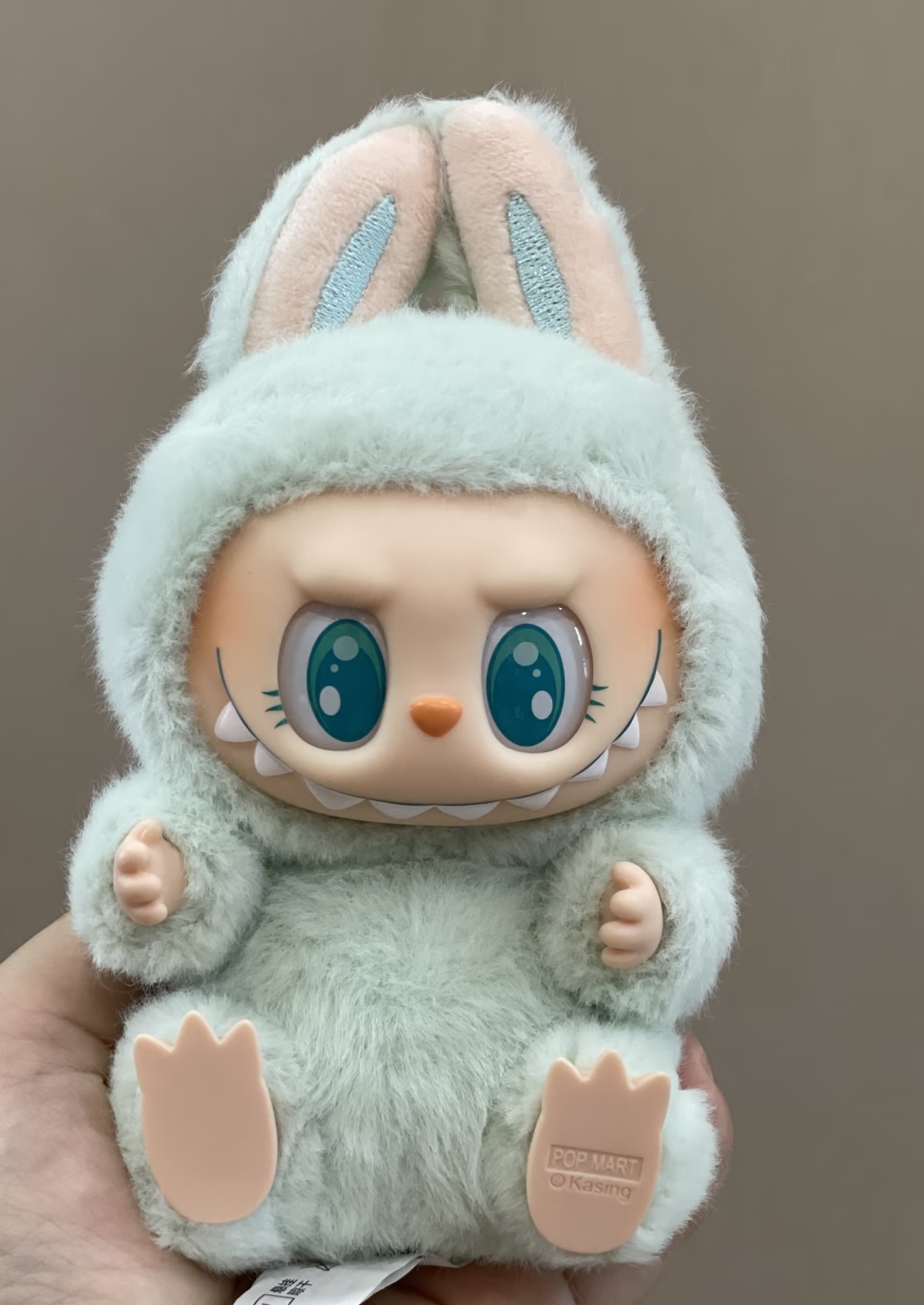
Let's get into the nitty-gritty. If you're serious about collecting, you need to become a detective. The clues are all there, you just need to know what you're looking for. This is the labubu and lafufu difference checklist I mentally run through whenever I see a suspicious listing.
Round 1: The `LABUBU vs Lafufu Box`
Before you even see the doll, the box will tell you 90% of the story. Counterfeiters almost always cut corners on packaging.
* Cardboard Quality: A real Pop Mart box has a premium feel. It's sturdy, with a smooth, almost soft-touch matte finish. A Lafufu box feels cheap. It's flimsy, glossy, and often has a slightly greasy feel to it. The corners are often pre-dinged right out of the factory. * Print Quality: Look closely at the artwork. A real box has incredibly sharp, vibrant printing. The lines are crisp. A Lafufu box looks like a bad photocopy. The colors are often oversaturated or washed out, and if you look very closely, you can see pixelation or a dot-matrix pattern. The text will be slightly blurry. * Foil and Embossing: Many LABUBU series boxes have foil accents or embossed details. On a real box, this foil is clean and precisely applied. On a Lafufu, it's often patchy, misaligned, or has a dull, plastic-like sheen instead of a metallic one. * The QR Code: This is a big one. Every official Pop Mart product has a QR code for their anti-counterfeit system. On a fake, this QR code might be missing, lead to a dead link, or take you to a sketchy, non-Pop Mart website. Real seller tip: I've seen fakes where they put a sticker QR code over the printed (and non-functional) one on the box. Huge red flag. If it's a sticker, be very suspicious.
Round 2: The `Lafufu Doll vs LABUBU` Figure Itself
Okay, you've opened the box. The moment of truth. What does a Lafufu look like up close? It looks like a sad, soulless imitation.
* Weight and Feel: The first thing I do is feel the weight. A real LABUBU has a pleasant heft. It's a solid piece of vinyl. A `lafufu doll vs labubu doll` will often feel noticeably lighter and more hollow. The material is different, a harder, cheaper plastic that lacks the smooth, slightly soft texture of real vinyl. Sometimes they even have a strong chemical smell, like a cheap beach ball. * The Face is the Place: This is where the artistry lies. On a real LABUBU, the eyes are painted with precision. They have depth. The iconic seven teeth are individually sculpted. The blush on the cheeks is a soft, airbrushed gradient. On a Lafufu, the eyes can be wonky, one might be higher than the other, or the paint is flat and lifeless. The teeth, as we discussed, are a mess. The blush is often a harsh, solid pink circle that looks like it was applied with a bingo dauber. * Paint Job: Pop Mart's quality control is excellent. The paint on a real LABUBU is clean, with sharp lines between colors. A Lafufu is sloppy. You'll see paint bleeding over lines, specks of the wrong color, and thin, patchy application where the underlying plastic color shows through. Check the small details. For example, on The Monsters Camping series, the campfire LABUBU has tiny, perfectly painted marshmallows on its stick. The Lafufu version? White blobs. * Articulation: A real LABUBU head turns with a smooth, snug resistance. It holds its pose. The arms have a similar quality feel. A Lafufu's joints are a disaster. The head might be super loose and wobbly, or so tight it feels like you'll snap the neck if you try to turn it. The arms will often just flop down.
This isn't just about aesthetics. It's about the entire experience and the integrity of the art. When you're trying to figure out how to tell the difference between labubu and lafufu, you have to use all your senses.
Real Talk: My Honest Take as a Seller
Look, I get it. You're scrolling online, you see a LABUBU Macaron set for $40, and you get excited. The real ones are sold out everywhere or marked up by resellers. The temptation is real.
But here's the thing. You are not buying the same product. You're not even buying a "good enough" version. You are buying a poorly made piece of plastic that infringes on an artist's creation. The lafufu meaning is, at its core, theft.
I've had customers bring fakes into my orbit, devastated. One person bought a "chase" figure, a secret from a set, for a "deal" at $80. The real one was trading for $200+. When we looked at it together, the poor quality was obvious. The paint was sticky. The box was flimsy. It was a Lafufu. They were out $80 and had a piece of junk they couldn't even display with pride. It's a terrible feeling.
The counterfeiters are getting better, too. The early Lafufus were laughably bad. Now, some "super fakes" are getting dangerously close, at least in photos. They're mimicking the boxes better, they're getting the colors closer. That's why knowing these subtle, physical tells is more important than ever. If you're new to the hobby, it's so easy to get duped, which is why I always recommend people start by checking out a guide on spotting fakes before they spend any serious money.
And honestly, you're missing the whole point of the hobby. Collecting designer toys is about celebrating the artist's vision. It's about the thrill of the hunt for an authentic piece, the joy of unboxing a beautifully made figure, and connecting with a community that appreciates the art. When you buy a Lafufu, you're cutting yourself off from all of that. You're just left with a cheap imitation.
Supporting Kasing Lung and Pop Mart means they can continue to create the amazing, whimsical world we love.It's a topic I feel strongly about, especially when you understand the journey of the artist behind the toy.
The Final Verdict: How to Protect Yourself
So, what are lafufus? They are a trap for new and hopeful collectors. The difference between labubu vs lafufu is the difference between art and a cheap copy.
The absolute best way to avoid getting a Lafufu is to buy from reputable sources.
1. Official Stores: Pop Mart's official website, their Amazon storefront, or their physical retail locations are your safest bet. You are 100% guaranteed to get an authentic product. 2. Authorized Retailers: These are specialty shops (like us at PopNya!) that have a direct relationship with Pop Mart or their distributors. We only sell authentic products because our reputation depends on it. You can browse our LABUBU collection with confidence, knowing everything is the real deal. 3. Resale Market (With Extreme Caution): If you must buy from eBay, Mercari, or Facebook groups, you have to be your own authenticator. Scrutinize every photo. Ask for more pictures if you're unsure. Compare the seller's photos to official product shots. If the price is too good to be true, it is a fake. No one is selling a real, rare LABUBU for 75% off the market rate out of the goodness of their heart.
Don't let the fear of Lafufu scare you away from the hobby. Just be smart. Educate yourself, trust your gut, and when in doubt, walk away. The joy of finally getting that one authentic LABUBU you've been hunting for is worth so much more than the fleeting, hollow victory of a cheap fake.
Happy (and authentic) collecting!
--- Disclosure: PopNya may earn a commission if you purchase through links on this page.


