

I remember the exact moment I went from a casual toy buyer to a full-blown LABUBU collector. It wasn't when I unboxed a rare figure. It was when I stumbled upon an image of a Kasing Lung painting online.
It was this chaotic, beautiful scene. A whole universe of his little monsters, not just LABUBU, but Zimomo, Tycoco, and Pato, all crammed onto a canvas. They were climbing, flying, and causing gentle mayhem. The colors were electric, but there was a softness to it, a storybook melancholy that the vinyl figures, as much as I love them, only hint at.
That's when it clicked. The toys are souvenirs from a world that already exists. A world that lives on paper and canvas. And honestly? I think in the mad rush for the latest blind box series, we're kind of forgetting about the most important part. The labubu art is the source code. It's the soul of the monster.
The Two Worlds of Kasing's Art
When people search for labubu artwork, they're usually looking for one of two things, even if they don't know it. There's the Kasing Lung of today, the fine artist whose large-scale acrylic paintings sell for tens of thousands of dollars at auction houses like Christie's and Phillips. And then there's the Kasing Lung of yesterday, the children's book illustrator from Belgium.
For me, the real magic started with that earlier work. If you ever get a chance to see his old labubu art, from his Chinese-language storybooks, you'll see what I mean. The style is looser, more whimsical. It's often watercolor and ink, with a delicate, almost fragile quality. The monsters feel younger, their world less defined and more mysterious. A labubu original drawing from this period is a true holy grail for collectors. It's not just a character portrait; it's a narrative moment, a frozen piece of a story you can feel but can't quite read.
This is a world away from the labubu painting you see in galleries now. His recent work is bold, confident, and dense with detail. He works primarily in acrylics on canvas, creating these massive, vibrant scenes that are just teeming with life. The compositions are incredibly complex. You can stare at one for an hour and still discover a new little monster hiding in a corner, or a funny interaction you missed.
I saw a piece from his "To Where the Wind Blows" exhibition sell for over 500,000 HKD (that's over $60,000 USD). It's incredible to see his work get that level of fine art recognition. But it also highlights the massive gap between the art and the toys. One is an accessible piece of pop culture for $15; the other is a serious investment piece hanging in a high-end gallery.
What Gets Lost in Translation (And What's Gained)
Don't get me wrong, I run a store that specializes in these figures. I love them. The process of turning a 2D drawing into a 3D figure is its own art form, and Pop Mart's sculptors are masters at it. They perfectly capture LABUBU's toothy grin, his long ears, and his mischievous posture. When you hold a figure from The Monsters Camping series, you feel that adventurous spirit.
But go look at the original paintings that inspired that series.
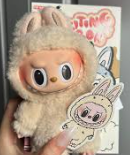
In the paintings, LABUBU isn't just standing there with a lantern. He's part of an ecosystem. You see the texture of the trees, the glow of the fire reflecting in the eyes of other creatures, the specific mood of the forest at night. The 3D figure is a perfect character study. The 2D labubu art work is the entire world that character lives in. The toy gives you the who; the painting gives you the why.
This is the core of Kasing Lung's genius. He's not just a character designer; he's a world-builder. His journey from a quiet illustrator to the creator of a global phenomenon is fascinating, and understanding it adds so much depth to collecting his work. If you want to really get it, you have to look past the toy and into the mind of the Labubu creator, Kasing Lung.
One detail I always notice is the eyes. In his older illustrations, the eyes are often simple black dots. They convey a pure, childlike innocence. In his newer, more complex paintings, the eyes have more detail, a hint of a reflection, a subtle shift in gaze. It's like we're watching the characters grow up and become more self-aware alongside the artist himself. The toys can't always capture that subtlety.
Real Talk: The Perilous World of Buying LABUBU Art
So, you love the art and want a piece for your wall. This is where it gets tricky.
Let's be brutally honest. An original Kasing Lung painting is likely out of reach for 99.9% of collectors. We're talking prices that are comparable to a new car. So, what's the alternative? Prints.
And this is my big warning as a seller who cares about this community: Be incredibly careful where you buy prints.
If you go on sites like Etsy or Redbubble and search "labubu art," you will find hundreds of options. Posters, canvas prints, stickers. Almost none of it is official. These are typically low-resolution images scraped from Google or Instagram, blown up, and printed without the artist's permission. The quality is usually terrible, and Kasing Lung sees zero dollars from the sale. You're essentially buying stolen art.
Official prints do exist, but they are rare and an event in themselves. They are usually released in collaboration with a gallery (like JPS Gallery or How2work) to coincide with an exhibition. These are limited-edition, often signed and numbered by Kasing, and come with a Certificate of Authenticity (COA).
Expect to pay anywhere from $500 to a few thousand dollars, depending on the edition size and image. But the quality is on another level. They're printed on heavy, archival-grade art paper that captures the texture and color of the original. A fake print from a third-party site might cost you $30, but it will look like a blurry photocopy on cheap poster paper. You get what you pay for. If a seller can't show you a COA or give you details about the edition number, walk away.
This scarcity and the desire for connection is, I think, a huge reason why everyone is drawing LABUBU themselves. When you can't own the official art, you participate by creating your own. The character design is so simple yet so expressive, it becomes a perfect canvas for people to project their own creativity and emotions. It's a beautiful, organic extension of Kasing's world.
Our Take
Look, the hype around the figures is fun. The thrill of the hunt, the joy of pulling a secret, the community around trading, it's all part of the experience. But if you're only focused on the vinyl, you're missing the heart of the story.
My advice? Spend some time with the art itself. Follow Kasing Lung on Instagram (@kasinglung). Find PDFs of his old exhibition catalogs. Zoom in on the high-res images from auction sites. See the brushstrokes. Notice the way he uses color to create a mood. See how LABUBU interacts with the other monsters in his universe.
Doing this has completely changed how I see the figures on my shelf. They're not just collectibles anymore. They're little ambassadors from a much larger, weirder, and more wonderful world. They're tangible pieces of a story that started with a pencil and a piece of paper.
When you understand the art, you understand the toy on a whole new level. You appreciate the choices the sculptors made. You recognize the little details that were carried over from a specific painting. It makes the whole experience richer.
So next time you're thinking about your collection, maybe think beyond the shelf. The figures are amazing, and we love helping people find the ones they're looking for. You can always browse our LABUBU collection to see how these stories take physical form. But remember that each one is a tiny echo of a much bigger picture. And that picture is where the real magic lives.
--- Disclosure: PopNya may earn a commission if you purchase through links on this page.


