

I get this email at least twice a week. "Hi, do you have the light purple labubu in stock?"
And my first thought is always: Which one?
This isn't me being difficult, I promise. It's because "the purple one" has become a catch-all for two, sometimes three, completely different and iconic figures in the Labubu universe. If you're new to collecting, you probably just saw a cute, rabbit-eared monster in a lovely shade of lavender on TikTok and thought, "I need that." I get it. That's how it starts for all of us.
But as someone who handles these little guys every single day, packing them up for new homes from our PopNya stockroom, I can tell you the differences are huge. The texture, the series, the market value, and even the vibe are worlds apart. You're likely looking for either the Exciting Macaron "Taro" Labubu or The Monsters Toys "Soy" Labubu.
So let's break it down, collector to collector.
The Crowd Favorite: Macaron Series "Taro"
This is almost certainly the light purple labubu you've seen the most. It's the one that often gets described as the pink and purple labubu because of its gorgeous gradient and little pinkish details. It comes from the "Exciting Macaron" series, which, frankly, was a smash hit for Pop Mart. We covered the series in-depth in our Honest Labubu Macaron Buyer's Guide, but Taro deserves its own spotlight.
First, the look. Taro is a beautiful, smooth, matte-finish vinyl. The color is a soft, dreamy lavender that fades into a creamy white on its belly and face. The ears have a slightly darker purple tip, and the little tuft of hair on its head is a delicate pink. It's holding a tiny macaron accessory. It's objectively adorable. The design is clean, simple, and incredibly photogenic, which is a huge reason for its viral fame.
But here's the real talk from a seller's perspective.
The quality on the Macaron series is generally very consistent. The paint application is clean, and the vinyl has a satisfying weight to it. It doesn't feel cheap. However, I have noticed a recurring, tiny issue on about 1 in every 20 Taros we've unboxed: a minuscule black speck embedded in the vinyl on the face. It's usually near the eye or on the cheek. It's not a paint flaw you can scratch off; it's in the material. Most people would never notice it, but if you're a perfectionist, it's something to be aware of when buying from a reseller. Always ask for close-up photos.
Market Value & Hype: The Macaron series retailed for about $15-$17 per blind box. Taro is one of the most popular regular figures in the set, alongside Lychee. When the series first dropped, its secondary market price shot up to around $40-$50. It has since cooled off a bit, but it consistently sells for $25-$35, still well above retail. It's a testament to its enduring popularity. It's not rare, but it is desired.
The biggest problem with Taro? Fakes. Because it's so popular, the counterfeit market is flooded.
Real Collecting Tip: The number one way I spot a fake Macaron Taro is the color of the macaron accessory it's holding. On the authentic figure, the macaron is a very specific shade of pale, almost dusty lavender. The fakes almost always get this wrong. Their macaron is either too bright, too saturated, or leans more towards a true purple. It's a subtle difference, but once you've seen the real one, the fake stands out immediately. The box is another tell, but the accessory color is my go-to tell when I see loose figures for sale.
The Collector's Choice: The Monsters Toys "Soy"
Now, if you're a bit deeper into the Labubu scene, you might be thinking of a completely different purple labubu doll. This one is "Soy" from The Monsters Toys series. And it is a different beast entirely.
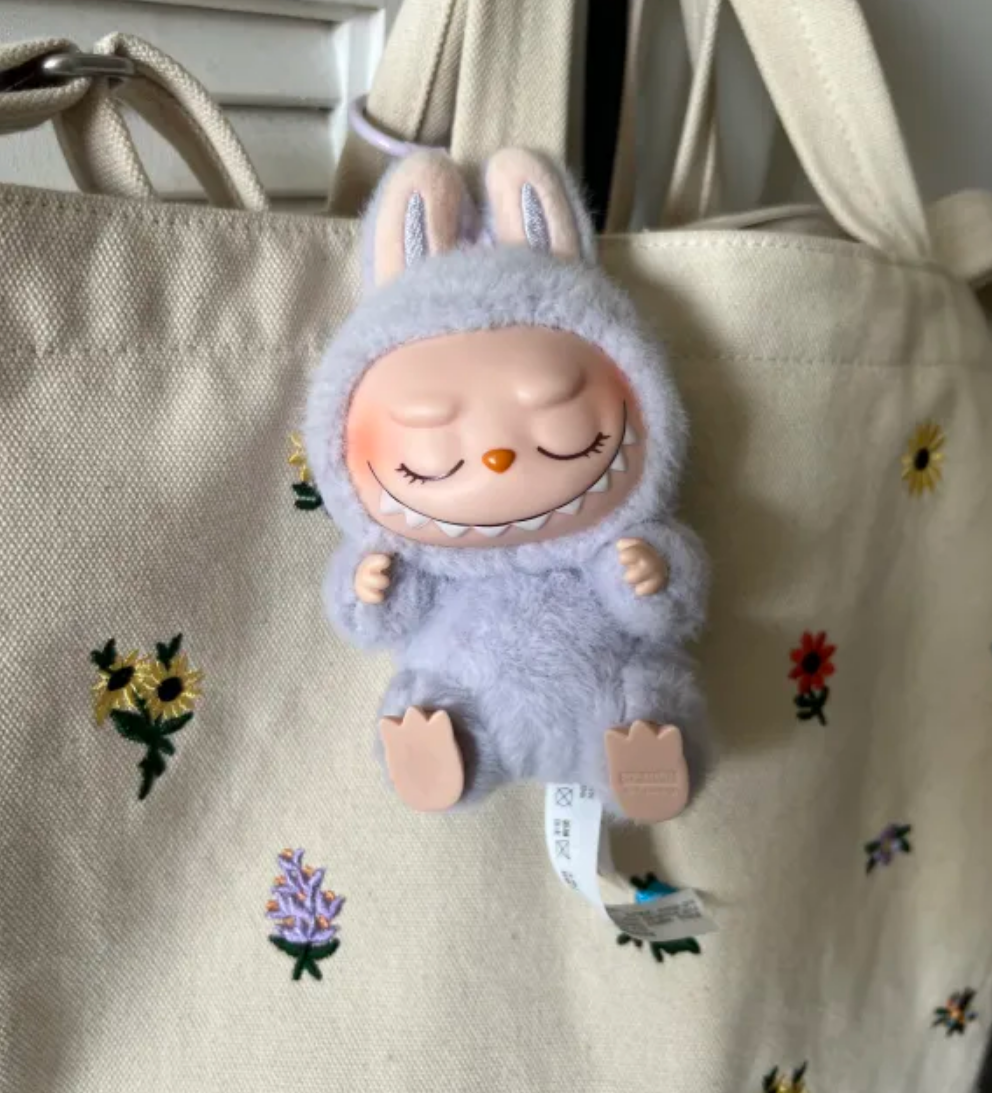
Where Taro is smooth and matte, Soy is flocked.
For the uninitiated, flocking is a process where tiny fibers are applied to the surface of the vinyl, giving it a soft, fuzzy, almost velvety texture. It's incredible to the touch. It makes the figure feel cozier, more like a tiny creature than a piece of plastic. The color is also different. Soy is a deeper, more muted, and dustier shade of purple. It's less "light and airy lavender" and more "moody twilight." It doesn't have the pink gradients of Taro; it's a solid, sophisticated purple.
I personally love the flocked figures. They have a premium feel that just hits different. But, and this is a big but, they are a pain to maintain.
The Flocking Warning: Flocking is a dust magnet. If you display it on an open shelf, it will need regular, gentle cleaning with a soft brush. It can also get stained or discolored if you handle it with dirty hands. Worse, the flocking can have factory flaws. I've seen figures with tiny bald spots, especially around sharp corners like the ears or nose. Sometimes the flocking is unevenly applied. It's part of the charm for some, but it drives other collectors mad. You have to be okay with a little bit of potential imperfection.
Market Value & Hype: The Monsters Toys series was a bit more of a niche release than the mainstream Macaron series. Because of this, Soy didn't have the same explosive viral moment. Its market value is more stable and, in my experience, a bit more unpredictable. It generally hovers around the $30-$40 mark, but I've seen it spike when a popular collector posts a photo of it. It's less common to find in the wild than Taro, which gives it a different kind of appeal. It feels more like a "find." It's the choice for the collector who wants something a little less mainstream, a little more unique.
The "Big Purple Labubu" – Let's Talk Plush and Mega
This brings us to the "big purple labubu" searches. This is where things get expensive. Usually, this refers to one of two things:
1. The Labubu Plushies: Pop Mart has released several large Labubu plush toys, some of which come in shades of purple. These are not blind-boxed. You buy the specific character you want. They are often released as limited editions and can be very hard to get. The most famous is probably the Zimomo "Tyrian Purple" plush, which is a darker, royal purple and fetches hundreds on the secondary market. They are big, cuddly, and make a huge statement on a shelf or bed.
2. The Mega Collection 400% or 1000% Labubu: These are the giant vinyl figures, similar to Be@rbricks. They are high-end collectibles, with the 400% size standing at about 11 inches tall. While there hasn't been a "light purple" one that's widely available, there have been purple-accented designs and special editions. For instance, the Labubu Big into Energy series had some incredible large-scale figures. These are a whole different level of collecting, with prices starting in the hundreds and going up into the thousands for rare editions. This is a transactional search, people looking for these are ready to buy a centerpiece for their collection.
Our Take: Taro vs. Soy – Which Purple Reigns Supreme?
So, if you came here wondering which light purple labubu to get, here's my honest verdict as a seller and a collector.
If you're just starting your collection, or you want that picture-perfect aesthetic you saw online, go for the Macaron "Taro." It's accessible, relatively affordable on the secondary market, and its design is undeniably classic. It is the peak of Labubu's mainstream popularity. It's a safe, beautiful bet. Just be vigilant about fakes.
However, if you're looking for a piece with more texture, a more unique feel, and a bit more of an "in-the-know" collector status, the flocked "Soy" is the one. You have to be prepared for the upkeep and the potential for minor flocking flaws, but the payoff is a figure that feels special every time you pick it up. It's less common, and that makes it more rewarding to own. It feels less like a toy and more like a small piece of art.
Personally? I have both on my desk. But if my shelf caught fire and I could only save one... I'd probably grab Soy. The flocked texture is just too good.
The beauty of collecting is that there's no right answer. From the smooth and sweet Taro to the fuzzy and moody Soy, the world of the purple labubu doll is surprisingly diverse. It's a rabbit hole, but a fun one to fall down.After all, the pink Labubu has its own cult following, too.
Disclosure: PopNya may earn a commission if you purchase through links on this page.


