

I get the email at least once a week. Sometimes it's a DM on Instagram. It always starts the same way: "Hi, do you have the leopard Labubu in stock?"
And my first thought is always, which one?
Because here's the thing that trips up so many new collectors: the figure you're probably thinking of, the one all over TikTok and Etsy with the bold spots, might not be an official Pop Mart release. It's a whole thing. A phenomenon, really. The search for the leopard labubu has created two parallel universes: the world of official releases and the sprawling, wild-west territory of custom figures.
As someone who handles these little monsters every single day for my shop, PopNya, I've seen the good, the bad, and the sticky (literally, bad paint jobs) of both worlds. So let's actually break down what you're looking for, what it's worth, and what you should watch out for.
The Official One: Meet "Big Cat" from the Big into Energy Series
First, let's talk about the official figure that comes closest to a leopard print. This is the guy you can pull from a real Pop Mart blind box.
His name is "Big Cat," and he's part of the Labubu Big into Energy series.
This series was a banger. The whole concept was Labubu getting hyped up on different "energy drinks," and each figure came with a tiny, adorable can. Big Cat is the cheetah-themed one. I remember when I first opened a case of this series for the store. When I pulled Big Cat, my first impression was that the design was more subtle than I expected. The spots aren't a harsh, black-on-yellow leopard print. They're more of a faded, brownish-orange cheetah spot pattern on a mustard-yellow body. It's less Lisa Frank and more, well, Kasing Lung. It has that slightly muted, storybook feel that defines his art.
He's got a little tuft of white fur on his chest and comes with a tiny "CAT" energy drink can. It's a fantastic detail. The quality on this series was solid, the vinyl has a nice weight, and the paint application on the ones I've handled has been consistently clean. No smudges, no weird textures.
Now, let's talk money. The Big into Energy series retailed for around $15-$17 per blind box. Since Big Cat is just a regular figure in the set (not a secret or a chase), his initial secondary market value wasn't crazy. For a while, you could find him for $25-$30.
But that was then.
As of late 2024, the Big into Energy series is no longer in active production. You won't find it sitting on the shelves of your local Pop Mart. This scarcity has pushed the price up. Right now, I'm seeing Big Cat consistently sell for $40 to $55 on secondary market platforms. We've sold a few at PopNya in that range, and they go fast. People are hunting for him to complete their sets, and the general Labubu hype has lifted all boats. If you're interested in the real deal, you can sometimes browse LABUBU figures from opened cases in specialized stores like ours to get the exact one you want without the gamble.
The "Cheetah Labubu" and the World of Customs
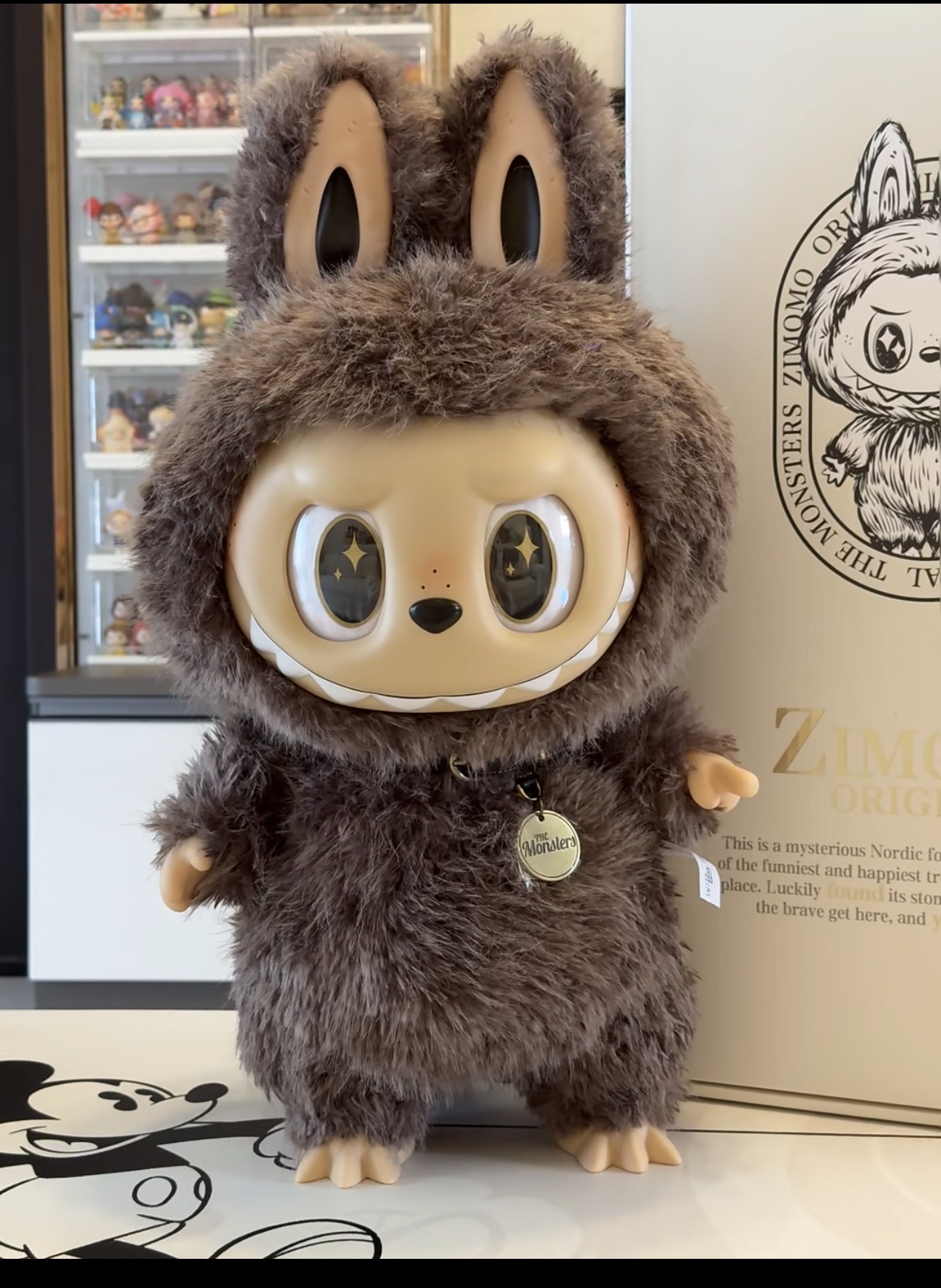
Okay, so if Big Cat is the official version, what are all those other leopard print labubu figures you see online?
Those are customs. 99% of them, anyway.
This is where the confusion really sets in. An artist will buy a basic, common Labubu, often a blank DIY one or a double they pulled from a series like Exciting Macaron Labubu, strip the paint, and create their own design. The leopard or cheetah print is an incredibly popular choice. It's bold, it's fashionable, and it looks amazing in photos.
You'll find them all over Etsy, Instagram, and Facebook groups. They range from simple black spots on a yellow base to intricate, multi-colored rosettes with glitter accents and glossy finishes. Some artists are incredibly talented, producing work that is, from a purely artistic standpoint, stunning.
But here's my honest warning as a seller and collector. Buying a custom is a totally different ballgame than buying an official product.
The Quality Gamble: The biggest issue is consistency. You are buying a piece of handmade art, not a factory-produced collectible. I have seen it all. I've seen customs with flawless, glass-like finishes. I've also received messages from distraught buyers who bought a cheetah labubu from a random seller, only for it to arrive with: * A sticky or tacky finish: This is a classic sign of using the wrong kind of paint or sealant (or not letting it cure). It's a dust magnet and feels awful to touch. * Chipping paint: The artist didn't properly prime the vinyl, and the paint flakes off at the slightest touch, especially around the joints in the ears and arms. * Brush strokes: In photos, it looked perfect. In hand, you can see every single brush stroke.
The Price: Custom artists set their own prices based on their time, materials, and perceived skill. A well-executed custom leopard Labubu can easily run you $80 to $150, sometimes more. You're paying for the artist's labor, not for an official collectible. This is a critical distinction. It has no "book value" in the collector's market. Its value is purely aesthetic and personal to you.
It's Not a Kasing Lung Piece: This might be a purist's take, but it's important. When you buy a custom, you're buying someone's interpretation of Labubu. You're not buying a piece of Kasing Lung's universe. For many collectors, a huge part of the appeal is owning a small piece of the world that the original artist created.
Our Take: The Real Talk on Which to Buy
So, which one should you get?
Look, I appreciate the hustle and artistry of the custom community. Some of the designs are genuinely creative. But if you're asking for my honest advice as someone who lives and breathes these toys?
For 9 out of 10 people, I recommend hunting down the official "Big Cat" from the Big into Energy series.
Here's why. It's an authentic piece. Its value is more stable and likely to appreciate over time as the series becomes harder to find. It's part of a collection with a theme and a story. You're getting the quality control of Pop Mart and the original design intent of Kasing Lung. It's the real thing. It might not be as flashy as some of the customs, but it has character and authenticity that can't be replicated with a paintbrush in someone's living room.
If you're a new collector, starting with official pieces is the best way to build a solid collection and learn what you truly love. Getting a feel for the real vinyl, the official paint jobs, and the intended designs is so important. It helps you develop an eye for quality and authenticity, which is a skill you'll need as you go deeper into this hobby. If you're just starting out, something like our ultimate guide to LABUBU dolls can be a good primer.
When does a custom make sense? If you are a seasoned collector, you have all the official releases you want, and you see a custom artist whose work you genuinely admire. Think of it as commissioning a painting. You're buying a one-of-a-kind art piece that happens to use a Labubu as a canvas. In that case, go for it! But do your homework. Ask the artist about their process. Look for reviews with photos from other buyers. Don't just trust the slick product shots.
How to Tell Them Apart in the Wild
This is the easy part once you know what you're looking for.
1. The Box: The official "Big Cat" comes in the Big into Energy blind box. If you're buying it loose, ask the seller if they have the original box and the little foil wrapper. Most serious collectors keep these. Customs are almost always sold loose or in non-official packaging. 2. The Design: Memorize what the official Big Cat looks like. The mustard-yellow body, the brownish-orange spots, the white chest tuft, and the specific "CAT" energy drink can accessory. Any deviation from this, brighter yellow, blacker spots, a different accessory, or no accessory at all, means you're looking at a custom. 3. The Price Tag: If you see a "leopard labubu" for $100, it's almost certainly a custom. The official Big Cat, while rising in price, isn't there yet. A price tag of $40-$60 is the current sweet spot for the real deal. Anything significantly higher or lower should be a red flag. 4. The Listing Description: Read carefully. Most reputable custom artists will state clearly that the figure is "customized," "hand-painted," or "OOAK" (one of a kind). If the description is vague, and the price seems too high for a regular figure, be suspicious.
The leopard labubu is a perfect example of how a fan community can take an idea and run with it, creating a whole sub-genre of art. It's cool, but it's also a minefield for buyers who don't know the difference.
My final piece of advice is this: decide what you're really after. Are you looking for a unique art piece to display? Or are you looking to own a part of the official Labubu story? If it's the latter, then the hunt for the "Big Cat" is your real quest. It's a super satisfying figure to finally add to your shelf, and a great representation of one of Labubu's most fun series. And if you ever get tired of the hunt, you can always check out our LABUBU collection to see what we've tracked down.
Happy hunting!
Disclosure: PopNya may earn a commission if you purchase through links on this page.


