

I need to be honest with you. I've been selling designer toys for a while now, and I thought I'd seen it all. The overnight sellouts, the wild secondary market prices, the desperate DMs from collectors. But the wave that was the happiness labubu was different. It wasn't just hype. It was a full-blown cultural tsunami that caught almost everyone, including us at PopNya, completely by surprise.
It all started with a simple enough collection: The Monsters "Big into Energy" Series. This was a set of vinyl plush pendants, basically little Labubu keychains you could clip onto your bag. Cute, right? The series had different emotions: Angry, So Sad, Befuddled, Sweet, and of course, Happiness. When we first got our stock, we figured they'd all sell pretty evenly.
We were so, so wrong.
Within days, one specific character started flying off the virtual shelves. The one with the big, toothy grin and cheerful pink-and-white striped outfit. The happiness doll. At first, it was just a trickle. Then a flood. Our entire inventory of the Happiness Labubu was gone, while the others sat there looking, well, befuddled. My inbox exploded. "Do you have Happiness?" "When are you restocking Happiness?" "I'll pay double for Happiness!"
It was madness. And for a while, I couldn't figure out why. Sure, it's cute. But is it that much cuter than the others? The answer, I soon discovered, had very little to do with the toy itself and everything to do with a Thai celebrity.
The "Happiness Bie" Effect: How a Celebrity Ignited a Firestorm
If you're in the Western collecting scene, you might have missed this entirely. But the key to this whole phenomenon lies in two keywords: happiness bie.
"Bie" refers to Thassapak Hsu, a popular Thai-Taiwanese actor and singer. In early 2024, his wife, actress Sumonthip "Gubgib" Hsu, and their family were seen with the Happiness Labubu plush. They featured it in social media posts, it was clipped to their bags, and it became an accessory in their very public, very stylish life.
And that was it. That was the spark.
In Asia, where celebrity influence is incredibly powerful, this was like pouring gasoline on a bonfire. Suddenly, it wasn't just a toy. It was a status symbol. It was a fashion accessory co-signed by one of the country's most beloved celebrity families. The search for "labubu bie happiness" went through the roof. Everyone wanted the exact same one they had.
This explains the sheer velocity of the trend. It wasn't a slow burn driven by collector forums. It was an instant, mainstream explosion. People who had never heard of Kasing Lung or Pop Mart were suddenly desperate to find this specific happiness doll. They weren't collecting the series; they were collecting a moment. A piece of celebrity-endorsed pop culture.
For us as sellers, it was a wild ride. We were getting orders from people who clearly weren't our usual customers. The demand was insatiable. We'd get a shipment in, and the Happiness plushes would be sold out in under a minute. The "So Sad" Labubu, ironically, was left looking even sadder on the shelf.
A Seller's Log: Watching the Market Go Parabolic
Let's talk numbers, because this is where it gets truly insane.
The "Big into Energy" plushes retailed for around $18-$22 USD, depending on the retailer. That's the price we sold them for. Standard stuff.
In the first week of the craze, I saw the Happiness Labubu hitting $50 on eBay. "Okay," I thought, "a little bit of hype tax. Normal."
A week later, it was $90.
By April 2024, at the absolute peak of the frenzy, I was seeing confirmed sales on platforms like StockX for $150 to $180. For a keychain. A keychain that was still being produced and retailed for under $25. It was pure, uncut speculative mania. We were getting dozens of emails a day from people offering to buy our entire stock, sight unseen, at a premium.
It created a massive headache. We want to sell to genuine collectors, but the market was flooded with scalpers using bots to snatch up every last unit. It became a constant battle. We had to add purchase limits, run CAPTCHAs, and do everything we could to give real fans a chance. It was exhausting.
The hype also put a huge strain on the supply chain. Pop Mart couldn't produce them fast enough. This scarcity, of course, only made the problem worse. It's a classic feedback loop: celebrity endorsement creates demand, demand creates scarcity, scarcity drives up resell prices, and high resell prices create more media buzz, which fuels more demand.
If you want a deeper look into how these hype cycles work for other series, our analysis of the Labubu Big into Energy series as a whole gives some context, but Happiness was truly a beast of its own.
Real Talk: Is the Happiness Labubu Worth the Hype?
Okay, let's put the market insanity aside for a second. Let's just talk about the object itself. I'm holding one in my hand right now.
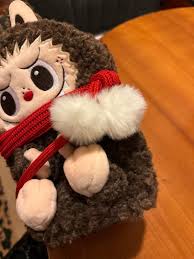
The plush material is soft, but it's a standard-grade polyester. It's not exceptionally luxurious. The vinyl face is classic Labubu, with that mischievous, toothy grin. The paint application on the face is generally clean, though I have seen a few from our batches with tiny smudges near the hairline, a common minor QC issue with mass-produced toys.
The striped outfit is cute and well-stitched. The little hood can be pulled up or down. The carabiner clip is a cheap-feeling aluminum. Honestly, it's the weakest part of the whole thing. I wouldn't trust it with my house keys. I've told customers to consider swapping it out if they're actually going to hang it on a bag they use daily.
So, is it a bad product? No, not at all. It's a perfectly charming, well-made little plush for its retail price.
But is it a $150 product? Absolutely not. Not even close. You're not paying for materials or craftsmanship at that price. You're paying for the story. You're paying for the trend. The quality is no better or worse than the "Angry" or "Befuddled" versions that you can still find for close to retail. It's not even as intricate as some of the blind box figures, like the ones in the Exciting Macaron Labubu series, which often have more complex paint jobs and accessories.
My honest seller's verdict: The Happiness Labubu is a fantastic example of how cultural context can transform an ordinary object into a coveted artifact. It's a symbol of a specific moment in time. If you got it for retail, congratulations. You have a super cute keychain with a great story. If you're thinking of paying the wild aftermarket prices... I'd urge you to reconsider. The joy you get from it might not be worth the financial sting once the hype inevitably fades.
A Quick Tip for Avoiding Fakes
With this level of hype comes the inevitable flood of fakes. They are everywhere. While our guide to spotting fake Macarons has some good general tips, here's one specific thing I've noticed on the fake Happiness plushes we've seen.
Check the teeth. On a genuine Happiness Labubu, the white paint of the teeth is crisp and has a very slight matte finish. The line where the teeth meet the pink inner mouth is sharp. On many of the fakes, the white paint is either too glossy or it bleeds slightly into the pink. It's a subtle difference, but once you've handled a real one, the fake just looks "off." The teeth on the fakes often look like they were painted on with cheap, shiny craft paint. Always buy from a reputable source. If a price seems too good to be true, it is.
The Hype Hangover
As of writing this, the market has started to cool. The $180 prices are gone. You can now find the Happiness Labubu for closer to the $50-$70 range on secondary markets. That's still a significant markup, but it's a sign that the fever has broken. The trend-chasers have moved on to the next hot thing, and the supply has finally started to catch up with the more sustainable, collector-driven demand.
This is the natural lifecycle of a hype product. It's a valuable lesson for anyone in this hobby. Chasing the hottest item is a fast way to burn out and empty your wallet. Sometimes the most rewarding part of collecting is ignoring the noise and just buying what you genuinely love. Maybe for you, that's the "So Sad" Labubu. Or maybe it's a completely different series altogether.
The Happiness Labubu will forever be a legend in the designer toy world. It's a case study in virality. It showed how quickly the line between a niche collectible and a mainstream fashion accessory can blur. It was stressful, chaotic, and utterly fascinating to witness from the inside.
And while my business brain loved the sales, the collector in me is kind of glad the madness is over. Now, we can get back to appreciating these little monsters for what they are: delightful pieces of art.com/collections/labubu) at your own pace. You might just find your own version of happiness there.
Disclosure: PopNya may earn a commission if you purchase through links on this page.


