

This question lands in my DMs at PopNya at least five times a week. It's always the same. A new collector, excited but nervous, sends a video of their brand new "Have a Seat" LABUBU. Their message is usually some variation of: "I tried to turn the feet and they won't budge. Is it fake?"
Honestly, I get it. You've seen the TikToks. You've scrolled through Instagram Reels showing a satisfying, smooth rotation of a LABUBU's little foot. So when you get yours and it's stiff as a board, panic sets in. Did you just get scammed?
The short answer is: probably not. But the long answer… well, that's where things get interesting. As someone who has unboxed, authenticated, and shipped hundreds of these little monsters, I can tell you the whole have a seat labubu feet situation is the single biggest point of confusion in the entire LABUBU community right now.
So let's clear the air.
The Official Stance vs. The In-Hand Reality
First, let's get the official word out of the way. Yes, authentic "Have a Seat" LABUBU figures from Pop Mart are designed to have posable feet. The joint is engineered to allow for rotation. This lets you adjust their posture slightly, whether they're sitting on your shelf or in the little chair they sometimes come with.
But here's the reality that Pop Mart's product page won't tell you. The execution of this feature varies. A lot.
I've opened brand new cases, direct from the distributor, and found figures inside where the feet are incredibly stiff. Like, "I'm-scared-I'm-gonna-snap-the-ankle-if-I-turn-this" stiff. This is especially true for figures that have been sitting in their boxes for a while, or maybe were part of an earlier production run. The plastic and the paint can settle, making that first turn a real nail-biter.
On the other hand, I've opened some where the feet move with a smooth, buttery resistance right out of the box. There's no rhyme or reason to it. It's not specific to one character in the series (Sisi can be just as stiff as Soya). It's just the nature of mass-produced designer toys. Tolerances aren't always perfect.
This variation is where the confusion starts. And it's the perfect environment for counterfeiters to thrive.
The Counterfeit Conundrum: Why Fakes Are So Confusing
The counterfeit market is fast. They see a popular series, they see the key features, and they replicate them, often poorly and with a complete misunderstanding of the original design intent.
The question of do real labubu feet move became a major talking point online. So, what did the fake factories do? They leaned into it. Hard.
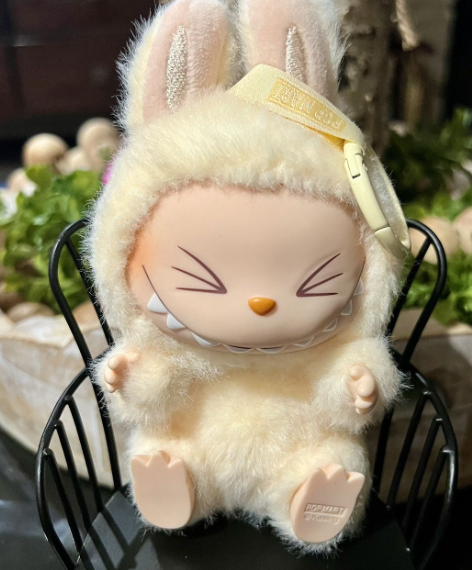
Most fake "Have a Seat" LABUBUs have feet that rotate. In fact, they often rotate too well. This is the number one thing I notice when I get a fake in my hands.
* The Fake Foot Feel: On a counterfeit, the rotation is often loose and janky. It feels light and cheap. There's no resistance. You can spin the foot around with your pinky finger. Sometimes you'll hear a dry, scratchy plastic-on-plastic sound. It might even have a slight rattle. The joint was made to be a gimmick, not a quality feature. * The Real Foot Feel: On an authentic LABUBU, the movement is completely different. When it does move, it's a firm, deliberate, and smooth glide. It feels like a high-quality joint. There's a satisfying tension to it, it's designed to hold a pose, not to be spun around like a top. It's almost always completely silent. Think of it like turning the focus ring on a high-end camera lens versus a cheap toy binocular. The difference is night and day.
The counterfeiters prey on the simple, binary question of "does it move?" They know new collectors will think "moves = real" and "doesn't move = fake." They've turned a minor feature into a major piece of misdirection.
Our Take: The Seller's "Feel Test"
Forget what you saw on TikTok for a second. If you're holding a figure and trying to decide if it's legit, the rotation is only one tiny piece of the puzzle. Here's what I actually look for, based on years of handling these figures. This is the stuff that's much harder for fakers to get right.
First, I apply gentle, even pressure. I'm not trying to force it. I'm just testing the resistance. A real one will feel solid, like one single, dense piece of vinyl. A fake often has a hollow, lighter feel.
Next, I look at the seam around the ankle. On an authentic figure, the seam where the foot part meets the leg part is clean, tight, and barely noticeable. The paint job goes over this seam flawlessly. On many fakes, this seam is wider, a little jagged, and you might even see a bit of flashing (excess plastic). Worse, if you do manage to rotate the foot on a fake, you'll often see the paint crack or flake around this joint. That's a massive red flag. Authentic Pop Mart paint is flexible and durable; it doesn't just chip off from a simple pose adjustment.
Then there's the material itself. Authentic LABUBUs have a very specific feel. It's a soft-touch, matte vinyl that feels premium and almost velvety. It has a certain density and weight. Fakes are typically made from a harder, shinier, cheaper-feeling plastic. They feel brittle. If you tap your fingernail on a real one, it makes a dull "thud." Tapping on a fake often produces a higher-pitched, hollow "click."
This is why relying solely on the foot movement is such a bad idea. A counterfeiter can easily make a joint that spins. It's much harder and more expensive for them to replicate the exact weight, material, paint quality, and finish of an authentic Kasing Lung creation. The character of LABUBU is in the details, and for anyone who has spent time with the real deal, you know that Kasing Lung's artistic vision is about more than just a rabbit with teeth; it's about the quality and feel of the object itself.
Real Talk: The "Foot Rotation Test" is a Terrible Authentication Method
Let me be blunt. Using the foot rotation as your primary, or only, method of authentication is a terrible idea. You are far more likely to get a false positive from a "good" fake or, even worse, damage a perfectly authentic figure.
I have a story about this. A few months ago, we got a restock of the "Have a Seat" series. I was going through them for a customer who specifically wanted one she could pose for photos. I opened a Soya figure, confirmed it was 100% authentic, box, card, smell, weight, everything was perfect. I tried to give the foot a gentle turn. Nothing. It was completely locked in place.
My experience told me not to force it. But for the sake of science (and this blog post, I guess), I decided to apply a little more pressure than I normally would. I wrapped the leg in a soft cloth to get a better grip and gave it a firm, steady twist. For a second, I felt a horrible, gut-wrenching resistance, and I was sure I was about to hear a sickening snap. I immediately stopped.
I put the figure under a warm lamp for about ten minutes (do NOT use a hairdryer, you'll melt the paint) just to soften the vinyl ever so slightly. Then I tried again. This time, with that same firm pressure, it finally gave way with a silent, smooth turn. It moved perfectly after that.
The lesson? Even a 100% real, brand-new figure can be so stiff that an inexperienced collector could easily break it trying to "test" it. You could snap the internal peg, and then you're left with a broken, wobbly foot that's in worse shape than any fake.
If you're worried about authenticity, there are much better ways to check. The quality of the printing on the box, the texture and details on the collector card, and the overall paint application are far more reliable indicators. I go over all of these in my in-depth guide to spotting fake LABUBUs, and I highly recommend using that as a checklist instead of risking damage to your figure.
The explosion in LABUBU's popularity, partly fueled by the trend of people drawing their own LABUBU fan art, has just made the counterfeit problem worse. More fans mean more potential customers for scammers.
So, What's the Final Verdict?
Here's the bottom line. The whole debate over the have a seat labubu feet is a classic case of the community focusing on the wrong detail.
1. Yes, authentic "Have a Seat" LABUBU feet are designed to rotate. It's a feature. 2. No, they don't all move easily right out of the box. Manufacturing variations mean some are stiff, and you should never, ever force them. 3. Yes, most fake ones rotate, often too easily. Counterfeiters use this feature as a way to trick buyers. 4. No, you should NOT use foot rotation as your main authentication test. It's unreliable and you risk breaking your figure.
My advice is to just... Relax. If your figure's feet don't move, don't panic. Check the other, more reliable signs of authenticity. If everything else checks out, you just have a stiff one. You can either leave it as is or very carefully try to warm it slightly and give it a gentle turn. But if it doesn't want to go, let it be. A static, authentic LABUBU is infinitely better than a broken one.
The joy of collecting these figures is in their charm, their design, and the fun of the hunt. Don't let a minor, inconsistent feature become a source of stress. If you're ever in doubt, the best thing you can do is buy from a reputable seller or, if you're lucky enough to have one nearby, an official Pop Mart store. And if you're looking to add to your monster family, you can always browse our LABUBU collection at PopNya, where we guarantee everything is 100% authentic, stiff feet or not.
Disclosure: PopNya may earn a commission if you purchase through links on this page.


