

Let's be honest. You probably saw a LABUBU on TikTok or Instagram, thought it was the cutest thing ever (you're not wrong), and frantically typed something like "lola boo boo doll" into Amazon or Google.
And then you saw them. Dozens of them. All looking kinda like the one in the video, but with weirdly shiny plastic, slightly-off colors, and a price tag of like, $9.99 with free shipping.
Welcome to the confusing, messy, and frankly, scammy world of LABUBU knockoffs.
As the owner of PopNya, I handle these little monsters all day. I see the pristine boxes from Pop Mart, I feel the quality of the vinyl, and I also hear the horror stories from customers who accidentally bought a fake. So let's clear this up. The term you're looking for is LABUBU. "Lola boo boo" is the internet's garbled, telephone-game nickname for the fakes that have flooded the market.
It's kind of like how fans have given LABUBU other funny names out of love. The community has a whole inside joke about calling them La Foo Foo, which is part of the fun. But "lola boo boo" isn't a term of endearment. It's a red flag. It's the name attached to the cheap imitations trying to cash in on the hype.
Why Are There So Many Fakes? A Quick Market Reality Check
Simple economics, really. LABUBU, designed by the amazing artist Kasing Lung and produced by Pop Mart, is on fire right now. When the Macaron series dropped, it was a bloodbath. I remember seeing individual figures that retail for about $17 CAD go for upwards of $60 on secondary markets within weeks. The demand is insane.
Pop Mart can't produce them fast enough to meet global demand, especially in regions where they're just starting to get a foothold. This creates a vacuum. And counterfeiters love a vacuum. They see a trending product, churn out a cheap version using low-grade materials, and list it on massive marketplaces where they can hide in plain sight.
They prey on newcomers to the hobby who don't know the difference yet. They're counting on you not knowing what to look for.
Real Talk: Why You Should Never, Ever Buy a "Lola Boo Boo"
Look, I'm a seller, but first, I'm a collector. I want you to love this hobby. And buying a fake is the fastest way to get disappointed.
It's not just about "supporting the artist," though that's a huge part of it. It's about the actual product you receive. Last month, a new collector came into my (admittedly small) shop space, looking defeated. She held up a "lola boo boo" she bought from a third-party Amazon seller.
The difference was staggering.
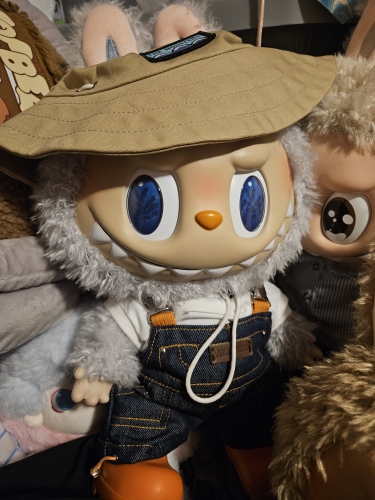
The fake was made of a hard, brittle plastic that felt greasy. It was so light it felt like a toy from a gumball machine. The real LABUBU has a satisfying weight and a smooth, almost soft-touch matte vinyl finish. But the worst part? The smell. The fake reeked of chemicals. That's not something you want in your house, let alone something a kid might play with.
We put it next to a real LABUBU from The Monsters Fall in Wild series I had on the shelf. The comparison was brutal. The paint on the fake's teeth was smudged and bled onto its "lips." The eyes were slightly crooked. The seams from the plastic mold were sharp and visible.
It wasn't a cute monster. It was a sad, toxic little goblin. She was out $15 and felt totally scammed. Don't let that be you.
The Collector's Playbook: How to Find Real La Boo Boo Dolls (aka LABUBU)
Okay, playbook time. You want the real deal. Here is my personal checklist, based on having handled hundreds of these figures, both real and fake. Bookmark this, screenshot it, tattoo it on your arm. Whatever works.
1. Start with the Box
Before you even see the figure, the box tells a story. * Printing Quality: A real Pop Mart box has crisp, vibrant printing. The lines are sharp, the colors are saturated. Fakes often look like a bad photocopy. The colors are dull, the images are blurry, and the text can be fuzzy. * The Official Seals: Look for the Pop Mart logo and the Kasing Lung artist credit. Most importantly, newer boxes have an anti-counterfeit sticker. This is usually a small, holographic sticker with a QR code that you can scan for verification. If that sticker is missing or looks like a cheap, non-holographic copy, run. * Cardboard Quality: Real boxes are made of sturdy, high-quality cardstock. They feel substantial. Fake boxes are often flimsy, thin, and get crushed easily in shipping.
2. The Figure Itself: The In-Hand Feel
This is where experience helps, but you can learn fast. * Weight: This is a big one. Real LABUBU figures have a pleasant heft. They feel solid and well-made. Fakes are notoriously lightweight and feel hollow and cheap. If you pick it up and your first thought is, "Wow, this is light," be suspicious. * Material & Texture: Authentic LABUBU is made from high-quality PVC vinyl. It has a smooth, matte finish that's lovely to touch. Fakes are often made from a cheaper, shinier plastic. Sometimes it feels oily or has a rough texture from the poor molding process. * The Smell Test: Don't be shy, give it a sniff. A new, real LABUBU has a faint, neutral "new toy" smell, like a new vinyl record. A fake often has a strong, sharp chemical or plastic smell that does not go away. It's the smell of cheap materials and questionable safety standards.
3. The Paint Job: The Devil's in the Details
Counterfeiters are lazy. They cut corners on the fine details because it saves time and money. * THE TEETH: This is the #1 tell for me. LABUBU's signature feature is its row of teeth. On a real la boo boo doll (the authentic LABUBU, that is), the white paint on the teeth is perfectly applied. The lines are razor-sharp and clean. On a fake, the paint is almost always a mess. It's sloppy, bleeds over the lines, and is sometimes unevenly applied. * The Eyes: Check the pupils. Are they clean, round, and looking in the same direction? Fakes often have misshapen pupils, paint specks, or a slightly wonky gaze. * Flocking: For series that include flocked figures (like the Zimomo mini-series), the difference is night and day. Real flocking is dense, soft, and velvety. It feels luxurious. Fake flocking is patchy, rough like cheap craft-store felt, and comes off easily on your fingers.
4. The Price Tag: The Ultimate Litmus Test
This is the simplest rule. If a deal looks too good to be true, it is.
A single, new blind box LABUBU retails for around $15-20 USD, depending on the series and retailer. No authorized seller is going to sell you a new, authentic LABUBU for $5, $8, or even $10. They just can't. The wholesale cost doesn't allow for it.
If you see a price that's drastically lower than the average, you are 100% looking at a fake. It's a loss-leader for a scammy shop or a straight-up counterfeit.
The world of collecting can be weirdly complex, and sometimes even the experts get confused. There are factory errors, prototypes, and one-off oddities that can muddy the waters. I even had a situation once where a piece I thought was a fake turned out to be a bizarre, but real, production part. But these are extreme edge cases. For 99.9% of what you'll see online, the playbook above will keep you safe.
Where to Safely Buy Authentic LABUBU
So, where DO you go? You've got a few safe harbors.
Official Pop Mart Channels: The most direct route. This includes their official website (popmart.com), their official Amazon or AliExpress storefronts (make sure it says "Sold by Pop Mart"), and their physical retail stores or Robo Shops if you're lucky enough to have one nearby. Stock can be hit-or-miss due to the high demand, but what you get is guaranteed to be real.
Authorized Retailers: This is us! Shops like PopNya are authorized, independent retailers. We have relationships with the official distributors. We get our stock through the proper channels, and we live and breathe these toys. Buying from a dedicated, reputable designer toy store means you're getting a real product, and you're supporting a small business that's passionate about the hobby.com/collections/labubu).
The Secondary Market (With Extreme Caution): Platforms like eBay, Mercari, or Facebook groups can be a place to find older or sold-out figures. But this is the wild west. You MUST do your homework. Check the seller's ratings, look at their other items, and scrutinize the photos using the playbook I just gave you. Ask for more pictures if you're unsure. If a seller refuses or gets defensive, that's a huge red flag.
Collecting LABUBU should be a joy. It's about the thrill of the hunt, the surprise of opening a blind box, and the delight of having Kasing Lung's incredible art on your shelf. It's not about deciphering which sketchy Amazon listing is going to send you a toxic-smelling piece of junk.
Now you have the knowledge. You can spot the fakes, sidestep the scams, and focus on the fun part: building a collection you truly love. Happy hunting.
--- Disclosure: PopNya may earn a commission if you purchase through links on this page.


