

The other day, a message popped up on our PopNya store chat. "Hi, do you have the sad Labubu?"
It wasn't the first time. It won't be the last. I get asked for the "anxious one," the "mischievous one," or the "one that looks like it's having a bad day" constantly. Nobody ever asks for "the one with the blue hat." It's always about the feeling.
And that's the whole thing with Labubu, isn't it? For a little monster with a static, toothy grin, it carries an incredible amount of emotional weight. People search for labubu emotions online because they're trying to put a name to the feeling they get when they look at one. They're trying to understand why this vinyl figure connects so deeply.
As someone who has unboxed hundreds of these, sold thousands, and kept a personal collection that's getting slightly out of hand, I have a theory. The magic isn't in what Labubu is explicitly showing us. It's in what it isn't.
That grin is a perfect blank canvas.
Is it a happy grin? A nervous grimace? The smirk of a creature about to cause some light-hearted chaos? Yes. It's all of those things and none of them at the same time. Kasing Lung, the artist behind The Monsters, gave Labubu an expression that is brilliantly ambiguous. Unlike a Funko Pop with its dead, empty eyes or a Smiski that's clearly doing one specific thing, Labubu meets you where you are.
If you're having a great day, its grin looks joyful. If you're feeling anxious, that same grin suddenly looks tense and uncertain. If you're feeling a little rebellious, it's the face of a co-conspirator. We project our own labubu feelings onto the toy, and it validates them right back at us. It's a tiny, silent therapist sitting on your desk.
The Market for Moods: Which Emotions Sell?
From a seller's perspective, this emotional projection has a very real, very measurable impact on the market. Not all Labubus are created equal, and their perceived emotion is a massive driver of value.
Let's talk about "Tears."
This figure is from The Monsters Toys Series, one of the earlier blind box collections. The design is simple: a standard Labubu, but with two big, blue, cartoonish tears streaming from its eyes. When it was released, it was just another one of the 12 designs in the set. You'd buy a box for around $15, and you had a 1-in-12 chance of getting it.
Today? I've seen "Tears" sell for over $100 on the secondary market. Easily. Why? Because it's one of the few Labubus with an explicit, undeniable emotion. And it's a "negative" one. In a world saturated with "live, laugh, love" energy, there's something incredibly validating about a collectible that just says, "Yeah, sometimes things are sad." People hunt for it. It's a grail piece for many collectors, not because it's the most intricate design, but because it is a feeling we all know.
On the other end of the spectrum, you have the purely mischievous ones. Take "Decon" from the same series. He's holding a spray can, looking like he just tagged a wall. He's not "evil", a topic some people get surprisingly worked up about, though it's really not that deep. He's just a little troublemaker. That one is also consistently popular. It is a playful defiance.
Then you have the "anxious" ones. The Monsters Exciting Macaron series is a fan favorite, and many of the figures in that set have this wide-eyed, slightly worried look. The Soymilk Macaron, with its off-white color and almost-panicked expression, is a perfect example. People see it and say, "That's me. That's my social anxiety in vinyl form." And they need it. The entire Macaron series is a masterclass in subtle emotional cues, which is why it's one of the most popular series to collect and display as a full set. If you're just starting out, browsing the current LABUBU collection is a great way to see this range for yourself.
**Our Take: The Real Reason We're Obsessed
Honestly, the whole Labubu emotions phenomenon is less about the toy and more about us. We're living in an era where it's finally becoming okay to talk openly about our feelings and mental health. We share "moods" on Instagram stories and identify with "chaotic good" alignment charts. Labubu has become an accidental, physical icon for this cultural shift.
Putting a "Tears" Labubu on your desk is a quiet, aesthetic way of acknowledging you're having a rough week. It's a conversation starter that doesn't require you to actually start the conversation. It's a way to wear your heart on your sleeve, or, well, on your shelf. Pop Mart and Kasing Lung didn't plan this. They couldn't have. It's a beautiful, emergent phenomenon driven entirely by the community. We've collectively decided this little monster is our emotional support cryptid, and that's that.
How the Community Writes the Story
The official lore from Pop Mart is minimal. Labubu is a monster who lives in a forest, has big ears, and a toothy grin. That's about it. The rest of the story? We're writing it.
The fan art community is where this really comes to life. Artists on platforms like Instagram and X (formerly Twitter) are constantly creating scenarios for Labubu that expand its emotional range far beyond the vinyl figures. You'll see drawings of Labubu going on dates, studying for exams, feeling lonely, or celebrating with friends. This is a huge reason why so many people are drawing Labubu; they're not just copying a character, they're contributing to its emotional narrative.
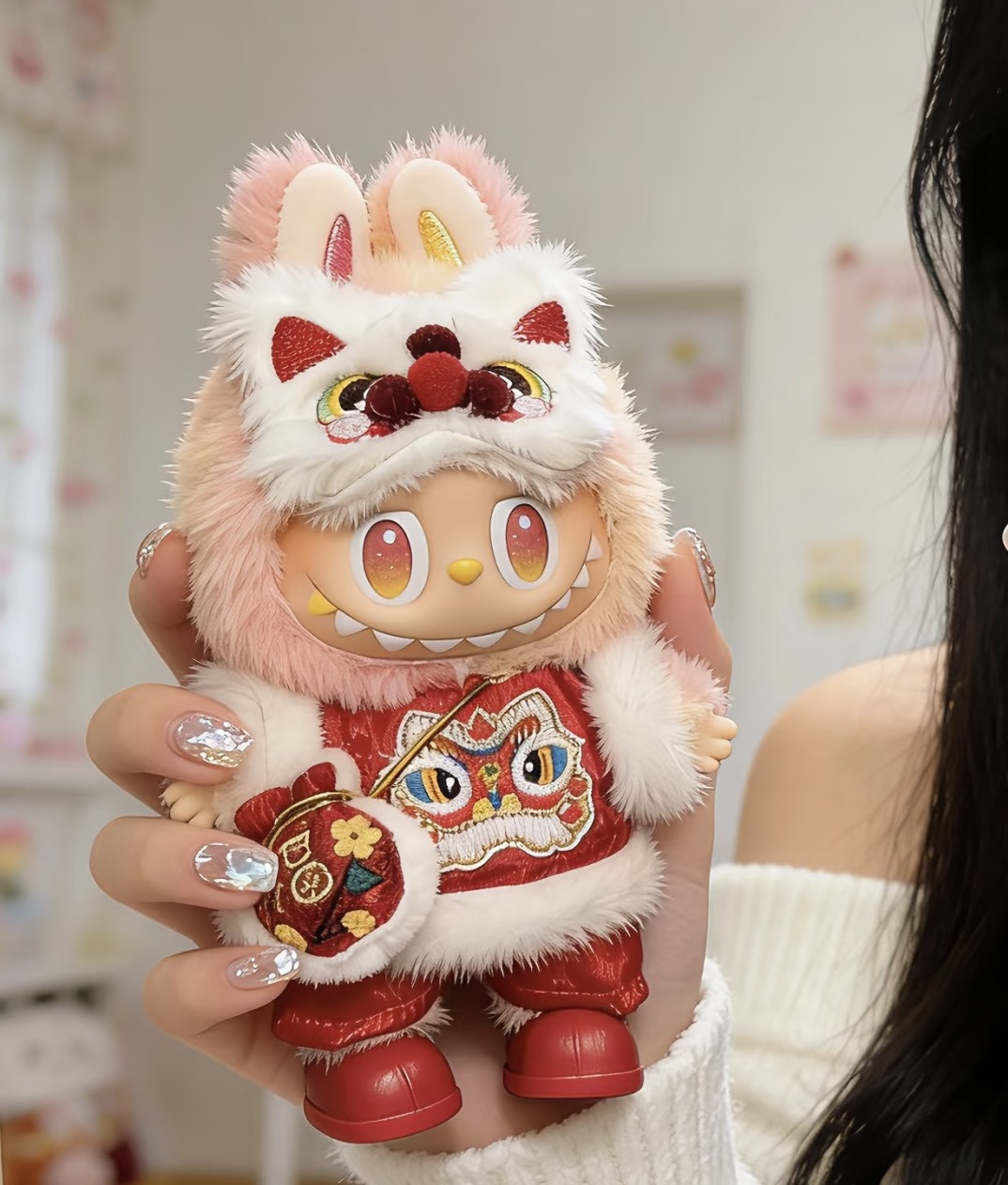
Then there's the dress-up culture. The standard 7cm Labubu is the perfect size for doll clothes from brands like Nendoroid or Obitsu11. People buy tiny hoodies, little hats, and miniature backpacks for their Labubus. They're literally clothing the "blank canvas" to better reflect a specific mood or personality. A Labubu in a raincoat looks pensive and cozy. The same Labubu in a tiny rock band t-shirt looks rebellious.
As a seller, I see this firsthand. We get questions about whether certain accessories will fit, or customers share photos of their customized figures. It's a level of interaction that goes way beyond just collecting. It's co-creation. Each person who buys a Labubu and gives it a little hat or a tiny prop is adding a sentence to the collective story of who this character is. If you're curious about the different figures people are customizing, you can see the huge variety in our list of LABUBU names and their corresponding series.
A Collector's Tip: Look for the Nuances
Here's something only a hardcore collector or someone who handles these daily would notice. The emotional read of a Labubu can sometimes vary slightly even within the same design due to tiny manufacturing differences.
I'm talking about millimeters of paint.
I once had two "Lychee" Labubus from the Macaron series side-by-side. On one, the tiny black dot of the eye was placed just a fraction of a millimeter higher. That one looked more alert and surprised. The other one's eyes were placed a bit lower, giving it a sleepier, more relaxed vibe. The mouth paint can also vary. A slightly thicker line can make the grin look more forced, while a thinner one can look more genuine.
These aren't errors, just the nature of mass production. But for collectors who are really tuned into the labubu feelings* of their figures, these tiny differences matter. It's part of the fun. You're not just getting a "Soymilk Labubu"; you're getting your* Soymilk Labubu, with its own unique micro-expression. It's a good reminder to be wary of fakes, as they often get these subtle details completely wrong. Learning how to spot a fake Labubu is a crucial skill, and the expression is often the biggest giveaway.
The evolution is also clear. If you compare one of the first Labubu series to a more recent one like The Monsters x Kow Yokoyama Ma.K. Series, you can see a shift. The newer designs are more complex. They have more accessories, more dynamic poses, and often, more specific contexts that guide the emotional interpretation. The original designs were simpler, leaving more to the imagination.
It seems Pop Mart has noticed the emotional connection people have and are leaning into it, creating figures that are more character-driven. It's a smart move, but I'll always have a soft spot for the early, more ambiguous designs. They were the ones that invited us in to create the story ourselves.
So, when someone asks me for the "sad Labubu," I know exactly what they mean. They're not just looking for a piece of vinyl. They're looking for a little piece of themselves, reflected back in a toothy, monstrous, and surprisingly understanding grin. And as I pack up their order, I can't help but smile. Because I get it. We all do.
--- Disclosure: PopNya may earn a commission if you purchase through links on this page.


