

I remember the first time I unboxed the Hirono Drummer Boy. It was from "The Other One" series, which, in my opinion, is still one of the most potent and emotionally raw collections Pop Mart has ever released. I wasn't specifically hunting for him; I think I was hoping for The Fox, like everyone else at the time. But when I unwrapped the foil and saw that little guy, with his oversized drum and quiet tears, I just stopped.
It wasn't just another cute toy. It felt… heavy.
And that's the thing about Hirono, isn't it? The artist, Lang, doesn't just create characters; he creates feelings. And the Hirono Drummer Boy meaning is a complex cocktail of emotions that so many of us instantly recognize. It's not just sadness. It's much, much more than that.
The Performance of Being Okay
At its core, the Drummer Boy is about performance. Look at him. He's geared up, ready to play. He has his instrument, his uniform (of sorts), and he's standing at attention. He is fulfilling a role. He is there to make a sound, to keep a beat, to be part of the parade.
But his face tells a completely different story.
The tears are the most obvious part, glossy and stark against the matte finish of his skin. This isn't a new-cry face, red and scrunched up. It's the face of someone who has been crying for a while, quietly, without anyone noticing. He is performing his duty while he is hurting.
And that, right there, is the first layer of the hirono story that resonates so deeply. It's the feeling of having to show up, put on a brave face, and go through the motions when you're falling apart inside. It's the pressure to contribute, to be productive, to "be okay" for the sake of others, even when you are fundamentally not okay. Have you ever had to sit in a meeting, plaster on a smile for a customer, or go to a family gathering while your world was crumbling? That's Drummer Boy. He is the patron saint of "faking it 'til you make it," except he's not even sure he wants to make it.
The Sound No One Hears
The drum is huge, almost comically oversized for his small frame. It should be loud. A drum is an instrument of announcement, of rhythm, of presence. It's meant to be heard, to command attention.
But the paradox of the Drummer Boy is the overwhelming sense of silence that surrounds him. You look at this figure and you don't hear a triumphant beat. You feel the heavy, muffled thud of a heart trying to keep going. The drum becomes a symbol of his inner turmoil. He's trying to make a sound, to express the enormous, deafening noise inside him, but it's as if no one is listening. Or maybe, he's beating the drum just for himself, a solitary rhythm to prove he's still there.
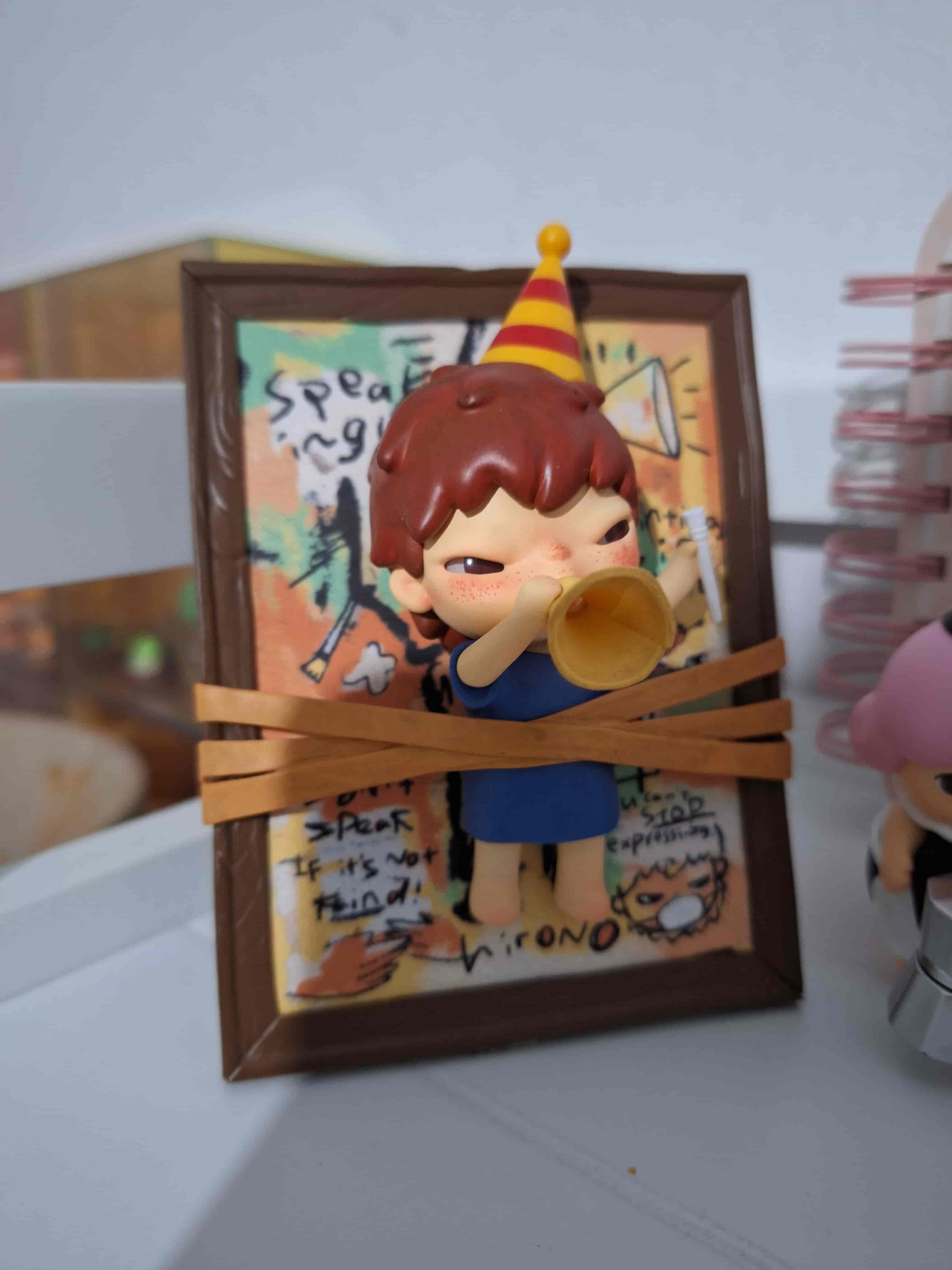
This is a recurring theme in the broader hirono figurine lore. Many of the characters are grappling with their place in the world, feeling unseen or unheard. They are surrounded by strange objects and situations that represent their internal struggles. The hirono persona is one of an outsider, an observer, a lost child navigating a world that doesn't quite make sense. Drummer Boy is a perfect embodiment of this. He has the instrument to make himself known, but he is trapped in his own quiet sorrow.
As a seller, I see which figures people connect with most. And Drummer Boy is consistently one of the most sought-after regular figures from "The Other One" series. When it first dropped, I saw people listing him for $35-40, while the retail for a single blind box was around $15. That price has stabilized, but the demand hasn't faded. People don't just want him to complete a set; they want him because they feel him. I've had more customers send me messages about this figure than almost any other non-secret Hirono. They say things like, "This is literally me at my job."
A Quick Detour: Drummer Boy vs. Echo
It's interesting to compare Drummer Boy to another Hirono figure that deals with sound: "Echo" from the "Reshape" series. I think looking at them side-by-side tells you a lot about the evolution of the hirono background and its themes.
The hirono echo backstory is about being trapped by the words and noises of others. He's literally encased in a bell, with his hands over his ears. The sound is external, an assault from the outside world that he is trying to block. It's about being overwhelmed.
Drummer Boy is the opposite. The sound is internal. He isn't trying to block noise out; he's trying to let his own noise out. The drum is his tool for expression, but it's also his burden. It's heavy. It's his responsibility. Echo wants silence from the world; Drummer Boy wants the world to hear his silence.
They are two sides of the same lonely coin, and seeing them together on a shelf is a powerful statement. It's this kind of subtle, emotional storytelling that makes the entire HIRONO collection so compelling for collectors who are looking for more than just cute designs.
The Weight and Feel: A Collector's Observation
Here's something you won't get from just looking at pictures online. The Drummer Boy figure has a specific physicality that adds to its meaning. When you hold it, you notice the weight is distributed oddly. The drum itself is hollow but the figure has a solid, dense feel. The drumsticks are incredibly delicate. I've seen more than a few of these on the secondary market with a snapped drumstick, so be careful if you're handling one.
But the most important detail, for me, is the texture. Most of the figure is a soft, matte vinyl. But the tears, the tip of his nose, and the little puddle at his feet are finished with a high gloss. When the light hits it, they look wet. It's a simple manufacturing choice, but it's devastatingly effective. It makes the sadness tangible. It's a detail that shows the level of thought that goes into the hirono meaning. It's not just a sad expression; it's the physical evidence of that sadness.
This is a stark contrast to a series like "Little Mischief." If you look at the hirono little mischief meaning, it's all about chaotic, almost joyful disruption. Those figures are about externalizing energy in a playful, anarchic way. Drummer Boy is the opposite: it's about the crushing weight of internalized energy.
Real Talk: Is Drummer Boy Overhyped?
Okay, let's be honest. Is the hirono drummer boy meaning as deep as we all make it out to be, or is it just a sad-looking toy that we project onto?
My take: It's both. And that's its genius.
The design is simple enough to be a blank canvas. Lang gives us the core elements: the performer, the instrument, the tears. We fill in the rest with our own experiences of heartbreak, duty, and quiet desperation. It's a collaboration between the artist and the collector.
However, I will say this: sometimes the focus on Drummer Boy overshadows other, equally poignant figures in "The Other One" series. The "Amnesia" figure, with its head literally detached and floating, speaks volumes about dissociation and identity loss. "The Ghost" figure, transparent and fading, is a haunting take on feeling invisible.
So, here's my honest advice as a seller and collector. Don't just hunt for the Drummer Boy because it's popular. If you're new to Hirono, I'd actually recommend buying a few random boxes from a series that speaks to you and letting the figures find you. The magic of the hirono backstory is in the discovery, in unboxing a character you didn't expect and realizing it tells a piece of your own story. You might find that "The Crow" or "Being Alive" speaks to you even more.
The beauty of the entire line is its emotional range. If you only focus on the one sad boy with the drum, you're missing the full symphony of what makes this hirono persona so enduring. It's not just about sadness; it's about resilience, confusion, curiosity, and the weird, lonely, beautiful struggle of just being a person. If you're curious, you can often find individual figures or full sets if you browse HIRONO figures on collector sites and in our shop.
Ultimately, the Hirono Drummer Boy is more than a piece of vinyl. It's a small, silent monument to a feeling that is universally understood but rarely spoken aloud. He keeps his beat, even with tears in his eyes. He shows up. And in his quiet, heartbreaking performance, he gives a voice to the silent struggles so many of us carry every single day. He doesn't offer a solution or a happy ending. He just offers recognition. And sometimes, that's more than enough.
Disclosure: PopNya may earn a commission if you purchase through links on this page.


